

Living as a traveler or digital nomad offers freedom that many people dream about. You can work from a beach in Thailand, spend a month exploring Portugal, or move between cities while running your business online. But this lifestyle also comes with a challenge—keeping your skills relevant in a fast-changing job market.
Many remote professionals rely on continuous learning to stay competitive. Whether you’re a freelance writer, software developer, virtual assistant, marketer, designer, or entrepreneur, learning new skills can open doors to better opportunities and higher income.
This is where Coursera has become one of the most recognized online learning platforms. It brings together courses from universities and organizations around the world, allowing learners to study from almost anywhere with an internet connection.
In this detailed Coursera review for 2026, we’ll explore what the platform offers, how it works, its advantages and limitations, and whether it’s a worthwhile investment for travelers and digital nomads.
One of the biggest misconceptions about remote work is that once you’ve learned a skill, you’re set for life.
In reality, industries change constantly.
AI tools are evolving every month.
Digital marketing strategies continue to shift.
Programming languages receive new updates.
Project management methods improve.
Companies increasingly expect professionals to understand automation, analytics, cybersecurity, cloud computing, and artificial intelligence.
For digital nomads, staying updated isn’t optional—it’s part of remaining employable.
Unlike traditional office workers who may receive company-sponsored training, freelancers and remote workers are usually responsible for their own professional development.
An online learning platform makes this much easier because you can learn:
During long flights
Between client projects
While staying in a hotel
From a co-working space
During slow travel days
While waiting at airports
Learning becomes something that fits around your travels instead of interrupting them.
Coursera is an online learning platform that partners with universities, educational institutions, and organizations to provide online courses across hundreds of subjects.
Instead of focusing on one specific topic, Coursera offers learning opportunities in areas including:
Artificial Intelligence
Machine Learning
Business
Marketing
Data Science
Cybersecurity
Programming
Cloud Computing
Finance
Project Management
Personal Development
Health
Language Learning
Graphic Design
Entrepreneurship
The platform includes individual courses, guided projects, Professional Certificates, Specializations, university certificates, bachelor’s degrees, master’s degrees, and other learning programs depending on the institution offering them.
Because courses are created by partner institutions, the teaching style, duration, and structure can vary.
Travel often means downtime.
Flights.
Train rides.
Airport layovers.
Bus journeys.
Rainy days.
Quiet evenings at hostels.
Instead of spending all those hours scrolling through social media, many travelers are turning that time into productive learning.
Imagine finishing a marketing certificate while backpacking across Europe.
Or learning Python while traveling through Southeast Asia.
Or completing project management training during a month in Bali.
Coursera makes this possible because learning is flexible.
You’re generally able to learn according to your own schedule rather than attending fixed classroom sessions.
For people constantly changing locations and time zones, that flexibility is incredibly valuable.
Coursera isn’t designed for only one type of learner.
It appeals to a wide variety of people.
Some of the most common users include:
Remote employees
Digital nomads
College students
Recent graduates
Entrepreneurs
Freelancers
Career changers
Small business owners
Professionals seeking promotions
Lifelong learners
For travelers, it provides an opportunity to continue growing professionally without sacrificing the freedom of exploring new destinations.
Traditional education often requires:
Fixed schedules
Physical attendance
Semester timelines
Commuting
Classroom participation
These requirements simply don’t work well for someone moving between countries every few weeks.
Coursera removes many of these barriers.
Most courses are delivered online through recorded video lectures, quizzes, assignments, readings, and practical exercises.
Because materials are available digitally, learners can progress at a pace that suits their own schedule, although some programs may include recommended deadlines to help learners stay on track.
One reason Coursera continues to attract millions of learners is the enormous range of available topics.
A traveler running a freelance business might choose:
SEO
Digital Marketing
Content Strategy
Google Analytics
Email Marketing
A software engineer could focus on:
Python
Java
Cloud Computing
Kubernetes
AWS
Machine Learning
Someone interested in business may explore:
Leadership
Finance
Entrepreneurship
Accounting
Negotiation
Creative professionals can study:
UX Design
Graphic Design
Visual Communication
Product Design
The diversity of subjects means many learners can continue building skills without needing multiple learning platforms.
One feature that makes Coursera stand out is its partnerships with universities and organizations.
Depending on the course, learners may study material created by leading educational institutions or major companies.
This gives learners access to academic-style content while studying from home—or from virtually anywhere in the world.
For digital nomads, that means you could be taking a university-developed course while sitting in a café overlooking the Mediterranean or relaxing in a mountain cabin.

Travel rarely follows a perfect schedule.
Flights get delayed.
Plans change.
Internet connections vary.
Sometimes you spend an entire day exploring a city instead of working.
Other days you’re indoors because of bad weather.
A rigid education schedule doesn’t suit this lifestyle.
Coursera’s flexible approach allows learners to continue where they left off whenever time becomes available.
You don’t need to organize your travels around a classroom timetable.
Instead, learning can fit around your adventures.
Absolutely—but consistency matters more than location.
Many remote workers dedicate just 30 to 60 minutes each day to learning.
That might happen:
Before breakfast
During a train ride
While waiting for a flight
After finishing client work
During evenings
Those small sessions gradually add up.
Over several months, learners can complete multiple courses or longer learning programs while continuing to travel.
This approach often feels much more manageable than trying to complete intensive classroom training.
For most learners, getting started is straightforward.
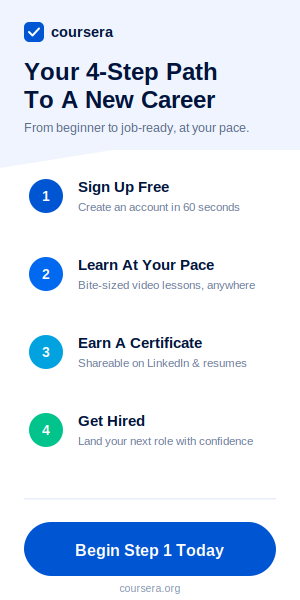
You create an account, browse available subjects, choose a course, enroll, and begin learning.
The course interface typically organizes lessons into modules, making it easy to keep track of your progress.
Within courses, you’ll commonly find:
Video lectures
Reading materials
Practice quizzes
Assignments
Discussion forums (where available)
Progress tracking
Because everything is organized by modules, it’s relatively simple to pause learning during busy travel days and resume later.
Self-paced learning is one of the biggest advantages for people who travel frequently.
Not every week looks the same.
Some weeks you’re focused entirely on client work.
Other weeks you’re crossing borders.
Some months are packed with sightseeing.
Others are quieter and allow for more focused study.
Coursera allows many learners to adjust their pace according to their schedule, making it easier to balance education with travel and work commitments.
Rather than feeling pressured by a rigid calendar, learners can often adapt their study routine as life changes.
At first glance, Coursera offers an impressive combination of flexibility, subject variety, and learning opportunities for people who work remotely or travel often.
Instead of putting your career on hold while exploring the world, it allows you to continue developing valuable skills wherever your journey takes you.
For digital nomads, that’s a powerful advantage.
But choosing an online learning platform isn’t only about convenience. Factors like pricing, certificates, course quality, learning experience, and overall value matter just as much.

One of the biggest reasons Coursera has become a popular learning platform is its straightforward learning experience. Whether you’re taking your first online course or returning to study after several years, the platform is designed to make it easy to find, enroll in, and complete courses.
The first step is creating a free Coursera account. After signing in, you can browse thousands of learning opportunities by subject, career path, skill level, language, university, or partner organization.
Each course page clearly explains what you’ll learn, the estimated time commitment, prerequisites (if any), instructor information, learner reviews, and whether the course includes a certificate upon successful completion.
This transparency helps travelers and digital nomads decide whether a course fits both their learning goals and travel schedule.
Coursera isn’t limited to standalone courses. Instead, it offers several different learning formats depending on your goals.
These include:
Individual Courses
Guided Projects
Specializations
Professional Certificates
MasterTrack® Certificates
University Certificates
Online Degrees
Career-focused learning paths
This variety allows learners to start with a short introductory course before committing to a longer learning journey.
For example, someone curious about digital marketing can begin with a single introductory course. If they enjoy the subject, they may later continue with a Professional Certificate or Specialization that explores the topic in greater depth.
Individual courses are often the simplest way to begin learning.
These courses usually focus on one specific topic or skill.
Examples include:
Introduction to Artificial Intelligence
Fundamentals of Project Management
Python Programming Basics
Business Communication
Data Visualization
Financial Planning
UX Design Fundamentals
Many learners appreciate that they can finish an individual course without committing to months of study.
For digital nomads balancing travel and work, this flexibility is particularly useful.
Sometimes watching video lectures isn’t enough.
Practical experience matters.
Coursera also offers Guided Projects that allow learners to work on real tasks while following step-by-step instructions.
These projects are generally shorter than full courses and focus on completing a practical objective rather than studying a broad subject.
For example, a learner might complete a project involving spreadsheet analysis, creating dashboards, designing presentations, or working with software tools.
For freelancers, these hands-on experiences can be especially valuable because they encourage learning by doing.
A Specialization combines multiple related courses into one structured learning path.
Instead of studying only one topic, learners gradually build expertise through several connected courses.
For example, a digital marketing Specialization might include modules covering:
Marketing strategy
Search engine optimization (SEO)
Social media marketing
Analytics
Digital advertising
By progressing through multiple courses, learners develop a broader understanding than they would from a single standalone class.
This structured approach works well for professionals planning a career transition or looking to deepen existing knowledge.
Professional Certificates are among Coursera’s most popular offerings.
These programs are designed to help learners develop job-relevant skills through a sequence of courses.
Unlike a traditional university degree, Professional Certificates focus on practical knowledge and workplace applications.
Many learners use these programs to:
Learn new technical skills
Prepare for entry-level roles
Strengthen their resumes
Build confidence before changing careers
For remote workers and digital nomads, these certificates can demonstrate a commitment to continuous learning while developing skills that support online work.
Coursera also hosts fully online degree programs offered by partner universities.
These include selected bachelor’s and master’s degree programs.
Unlike short courses, degree programs involve a much larger time commitment and follow the academic requirements established by the participating university.
For travelers considering higher education without relocating to a campus, online degrees provide another learning option.
However, because degree programs require sustained commitment over a longer period, they’re generally better suited to learners with stable schedules than those who are constantly moving.
Most courses follow a consistent weekly structure.
You’ll typically encounter:
Short video lectures
Reading assignments
Knowledge checks
Practice quizzes
Graded quizzes
Peer-reviewed assignments (for some courses)
Discussion forums
Final assessments
Rather than sitting through several hours of uninterrupted lectures, lessons are usually divided into shorter videos.
This format works particularly well for busy professionals.
If you’re waiting for a train in Spain or relaxing in a café in Vietnam, completing a few short lessons feels much more manageable than watching an entire lecture.
One of Coursera’s strongest features for travelers is flexibility.
Many courses allow learners to study according to their own schedule.
You can complete several hours in one weekend or spread lessons across multiple weeks.
This flexibility becomes especially valuable when travel plans change unexpectedly.
Imagine spending several days hiking with limited internet access.
Instead of falling behind in a classroom, you can simply continue learning once you’re connected again.
For digital nomads, this freedom removes much of the stress associated with balancing education and travel.
Many digital nomads rely heavily on smartphones and tablets while traveling.
Coursera supports learning across multiple devices, making it convenient to continue studying whether you’re using a laptop in a coworking space or a phone during a train journey.
Being able to switch between devices allows learners to make use of small pockets of free time throughout the day.
Even completing one lesson during an airport layover can help maintain learning momentum.
Reliable internet isn’t always available while traveling.
Whether you’re on a long-haul flight or visiting remote destinations, staying connected isn’t guaranteed.
Coursera provides options within its mobile app that allow eligible course content to be downloaded for offline viewing. Availability can vary depending on the course and content type.
For travelers spending long hours in transit, offline access can make learning much more convenient.
Many Coursera courses offer a shareable certificate after successfully completing all required coursework, provided the learner is enrolled in the certificate track or paid version where applicable.
These certificates can be added to:
LinkedIn profiles
Personal portfolios
Resumes
Professional websites
While certificates alone don’t guarantee employment, they can demonstrate initiative and ongoing professional development.
For freelancers competing internationally, showcasing recently acquired skills may help strengthen client confidence.
This is one of the most frequently asked questions.
The value of a certificate often depends on several factors:
The specific skills you’ve learned
Your existing experience
Your portfolio
The job you’re applying for
Employer expectations
For many employers, practical ability remains the most important factor.
However, completing structured learning programs can demonstrate commitment to improving your skills.
For freelancers, certificates can also serve as conversation starters with potential clients who want evidence of continued learning.
If you’re building a location-independent career, certain skills tend to have broad applications across industries.
Popular learning areas include:
Artificial Intelligence
Prompt Engineering
Data Analytics
Project Management
Digital Marketing
SEO
UX Design
Graphic Design
Python Programming
Web Development
Cloud Computing
Cybersecurity
Excel
Business Writing
Leadership
Entrepreneurship
These skills can support freelance work, remote employment, online businesses, and consulting opportunities.
One concern many travelers have is whether they’ll actually have time to finish a course.
Fortunately, Coursera offers programs with varying lengths.
Some Guided Projects can be completed relatively quickly, while Specializations and Professional Certificates generally require a longer commitment.
Each course page includes an estimated workload, allowing learners to choose options that fit their schedule.
Someone preparing for a month-long backpacking trip might choose a shorter course, while a slow traveler spending several months in one destination may decide to pursue a longer certificate program.
Many courses are designed for beginners, while others require previous knowledge.
Course descriptions usually indicate the recommended experience level, making it easier to select an appropriate starting point.
If you’re completely new to coding, data analysis, or business management, introductory courses provide a gentle entry into the subject before progressing to more advanced material.
This step-by-step approach helps reduce the intimidation often associated with learning technical skills.
Learning online doesn’t necessarily mean learning alone.
Many courses include discussion forums where learners can ask questions, share insights, and interact with other participants.
Because Coursera attracts learners from around the world, these discussions often include perspectives from different industries and countries.
For digital nomads who frequently work independently, participating in these communities can add a sense of connection to the learning experience.
One challenge of long-term travel is staying professionally relevant.
Technology evolves quickly.
Industries change.
New tools appear regularly.
By dedicating a small amount of time each week to learning, travelers can continue developing skills without interrupting their lifestyle.
Instead of returning home after a year abroad with an outdated résumé, you may have completed several courses that demonstrate continued professional growth.
This balance between exploration and education is one of Coursera’s biggest strengths for location-independent professionals.
After exploring how Coursera works, it’s clear why so many remote workers and travelers choose the platform. The wide range of learning formats, flexible study schedules, practical projects, and opportunities to earn shareable certificates make it well suited to people who aren’t tied to a traditional classroom or office.
However, no platform is perfect. Before deciding whether Coursera deserves your time and money, it’s important to consider its pricing, the pros and cons, how it compares with alternatives, and whether it’s the right fit for your travel lifestyle and career goals.
One of the first questions most people ask before enrolling is, “How much does Coursera cost?”
The answer depends on the type of learning program you choose.
Coursera offers both free and paid learning options. Many courses allow learners to access certain course materials for free, while features such as graded assignments and shareable certificates may require payment. Pricing also varies depending on the course, Professional Certificate, Specialization, or degree program.
Because pricing can change over time and differs by program and region, it’s always best to check the latest fees on the individual course page before enrolling.
This flexibility means learners aren’t forced into a one-size-fits-all pricing model. Instead, they can choose a learning path that matches both their educational goals and budget.
Whether a paid Coursera program is worth the investment depends largely on your objectives.
If you’re simply curious about a subject, a free course or introductory module may be enough.
However, if you’re looking to:
Learn a new career skill
Build a structured learning plan
Complete graded assessments
Earn a shareable certificate
Develop practical knowledge for work
then a paid program may provide additional value.
For many digital nomads, investing in education can be just as important as investing in travel gear or software subscriptions. A new skill that helps you secure higher-paying freelance projects or remote employment can often provide long-term benefits.
After exploring the platform in detail, several strengths stand out.
The ability to study around your own schedule is one of Coursera’s biggest advantages.
Whether you’re spending a week in Tokyo, taking a train across Europe, or relaxing in a beach town in Mexico, you can often continue learning whenever it suits you.
Few online learning platforms cover as many professional and academic subjects as Coursera.
Whether you’re interested in technology, business, health, design, finance, or personal development, there’s a strong chance you’ll find relevant learning opportunities.
This makes Coursera a platform that many learners can continue using throughout different stages of their careers.
Coursera collaborates with universities and organizations to offer educational content.
For learners, this means access to structured courses developed by experienced educators and industry professionals.
This partnership model has helped establish Coursera as one of the best-known names in online learning.
Instead of searching for random tutorials across the internet, learners can follow organized programs that gradually build knowledge.
This structure helps reduce confusion and makes it easier to stay focused on long-term goals.
Many paid programs provide shareable certificates upon successful completion.
These certificates can complement a portfolio or résumé and demonstrate ongoing professional development.
While practical skills remain the most important factor in most hiring decisions, certificates can help show your commitment to learning.
Few lifestyles benefit from online education as much as digital nomads.
Remote workers often need to adapt to changing technologies, industries, and client expectations.
Coursera provides a practical way to continue learning without interrupting travel plans.
No learning platform is perfect, and Coursera has a few limitations that prospective learners should understand.
Although free learning options are available, certificates and graded assessments often require payment.
Some learners expecting unlimited free access may find this disappointing.
Online learning offers flexibility, but that flexibility comes with responsibility.
Without classroom schedules or instructors reminding you to study, motivation must come from within.
Travelers especially may find it tempting to postpone lessons while exploring new destinations.
Creating a consistent study routine can help overcome this challenge.
Because courses are created by different universities and organizations, the teaching style, presentation, and level of detail naturally vary.
Some courses are highly interactive, while others rely more heavily on video lectures and reading materials.
Reading learner reviews before enrolling can help set expectations.
Professional Certificates and Specializations can take weeks or months to complete.
If you’re planning a fast-paced backpacking trip with limited study time, a shorter course or Guided Project may be a better choice.
Learning while traveling becomes much easier with a few simple habits.
Consider these strategies:
Set aside 30–60 minutes for learning each day.
Download eligible lessons before long flights or train rides.
Use quieter travel days to complete quizzes or assignments.
Focus on one course at a time instead of starting several.
Apply new skills immediately to freelance work or personal projects.
Keep notes to review during downtime.
A steady routine often leads to better progress than trying to complete large amounts of coursework in a single session.
The rise of remote work has created demand for professionals with practical digital skills.
Whether you’re a freelancer, entrepreneur, or remote employee, continuing to learn can help you stay competitive.
Some examples include:
Freelance Writer
Learning SEO, content marketing, AI tools, or analytics can improve the value you offer clients.
Virtual Assistant
Courses in project management, spreadsheets, communication, and productivity tools can broaden your services.
Web Developer
Programming, cloud computing, cybersecurity, and software development courses can help you keep pace with industry changes.
Digital Marketer
Learning about data analytics, AI, advertising, and marketing strategy can strengthen campaign performance.
Business Owner
Entrepreneurs can explore leadership, finance, operations, negotiation, and customer experience to grow their businesses.
In each case, the goal isn’t simply earning a certificate—it’s gaining practical knowledge that can be applied in real-world situations.
Coursera may be a good fit if you:
Work remotely.
Travel frequently.
Want to build professional skills.
Enjoy self-paced learning.
Are considering a career change.
Need flexibility around work or travel.
Prefer structured learning instead of random online tutorials.
It may be less suitable if you prefer face-to-face classroom interaction or find it difficult to stay motivated without external deadlines.
Yes. Its flexible learning model makes it suitable for people who work and travel, allowing many learners to study according to their own schedules.
Yes. Since courses are delivered online, travelers can continue learning from many locations with internet access. Some eligible course content can also be downloaded for offline viewing in the mobile app.
Generally, certificates that you’ve earned do not expire. However, the relevance of certain skills may change over time as industries evolve, so continuing education remains important.
Yes. Many courses are designed specifically for beginners, while others are intended for intermediate or advanced learners. Course descriptions indicate the recommended experience level.
Many learners use Coursera to develop new skills, explore different career paths, or deepen existing expertise. Career outcomes depend on many factors, including your experience, portfolio, and how you apply what you’ve learned.
For travelers and digital nomads, few investments offer as much long-term value as learning new skills.
While exploring new countries creates unforgettable experiences, continuing your education helps ensure your career grows alongside your travels.
Coursera stands out because it combines flexibility, a broad catalog of subjects, structured learning paths, and courses developed with universities and organizations. Whether you’re interested in artificial intelligence, business, project management, design, data analytics, marketing, or programming, the platform provides learning opportunities that can fit around a location-independent lifestyle.
No platform is perfect. Success with Coursera depends on your commitment, consistency, and willingness to apply what you learn. Certificates alone won’t replace practical experience, but the knowledge and skills gained through well-chosen courses can strengthen your professional profile and help you remain competitive in an evolving job market.
If you’re a digital nomad looking to sharpen your expertise between adventures, a freelancer aiming to expand your services, or a traveler who wants to make productive use of downtime, Coursera is certainly worth considering.
The most rewarding journeys aren’t only measured by the countries you visit—they’re also defined by the skills you build along the way. By combining travel with continuous learning, you can return from every trip with not only great memories but also new knowledge that supports your personal and professional growth.