

For a lot of people, commuting by bike sounds simple until you actually do it every day. There is the traffic, the changing weather, early mornings, evening rides, parked cars, intersections, buses, delivery vehicles and drivers who may not always notice a cyclist until the last second. Add an e-bike to the equation and the conversation around riding gear becomes even more important.
A helmet is still the starting point. But today’s commuters have more options than the traditional lightweight cycling helmet with a few ventilation holes. Smart helmets now combine conventional helmet protection with features such as integrated lighting, turn signals, brake lights, connectivity and crash alerts.
One of the more interesting options in this category is the UNIT 1 AURA Mips.
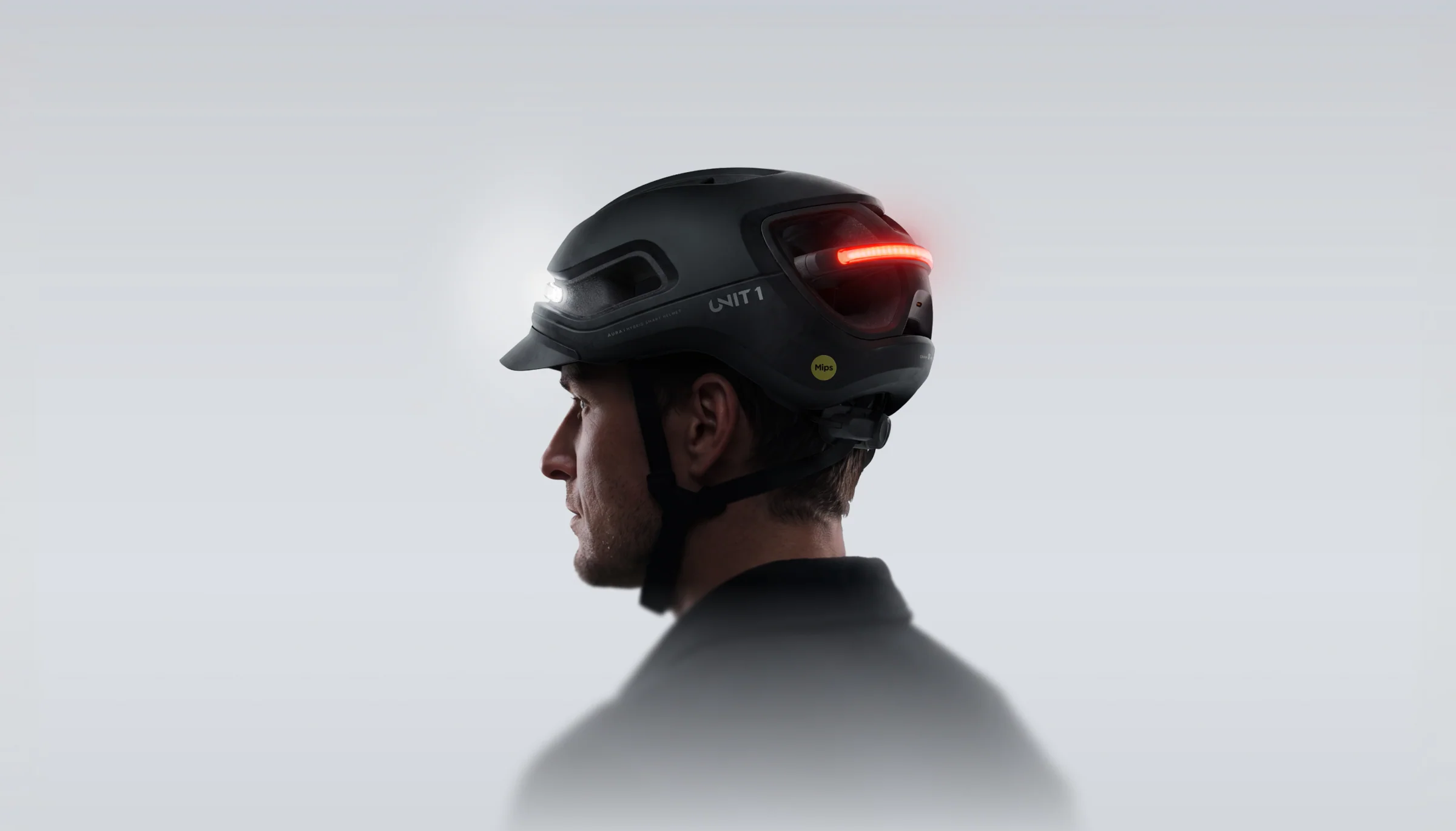
UNIT 1 positions the AURA as a hybrid smart helmet designed for both city riding and road cycling. The current AURA Mips model combines MIPS protection, NTA 8776 e-bike certification, CPSC and EN 1078 certifications, integrated front and rear lights, automatic brake lighting, turn signals through the UNIT 1 Remote, and Crash Alert functionality through the UNIT 1 app.
That combination makes the AURA Mips worth looking at if your idea of a bike commute goes beyond a short ride around a quiet neighborhood.
This review looks at what the helmet actually offers, how its features fit into everyday US commuting, what to know about its size and technical specifications, and where it makes the most sense compared with a conventional bicycle helmet.
A smart bike helmet is still a helmet first. The basic job does not change: it should fit correctly and provide certified protection appropriate for the type of riding you are doing.
The difference is that a smart helmet can integrate electronic and connected features into the helmet itself.
For a commuter, that can mean having lights built directly into the helmet rather than attaching a separate rear light. Depending on the model, smart functionality can also include turn indicators, automatic braking lights, smartphone connectivity, crash detection and other controls.
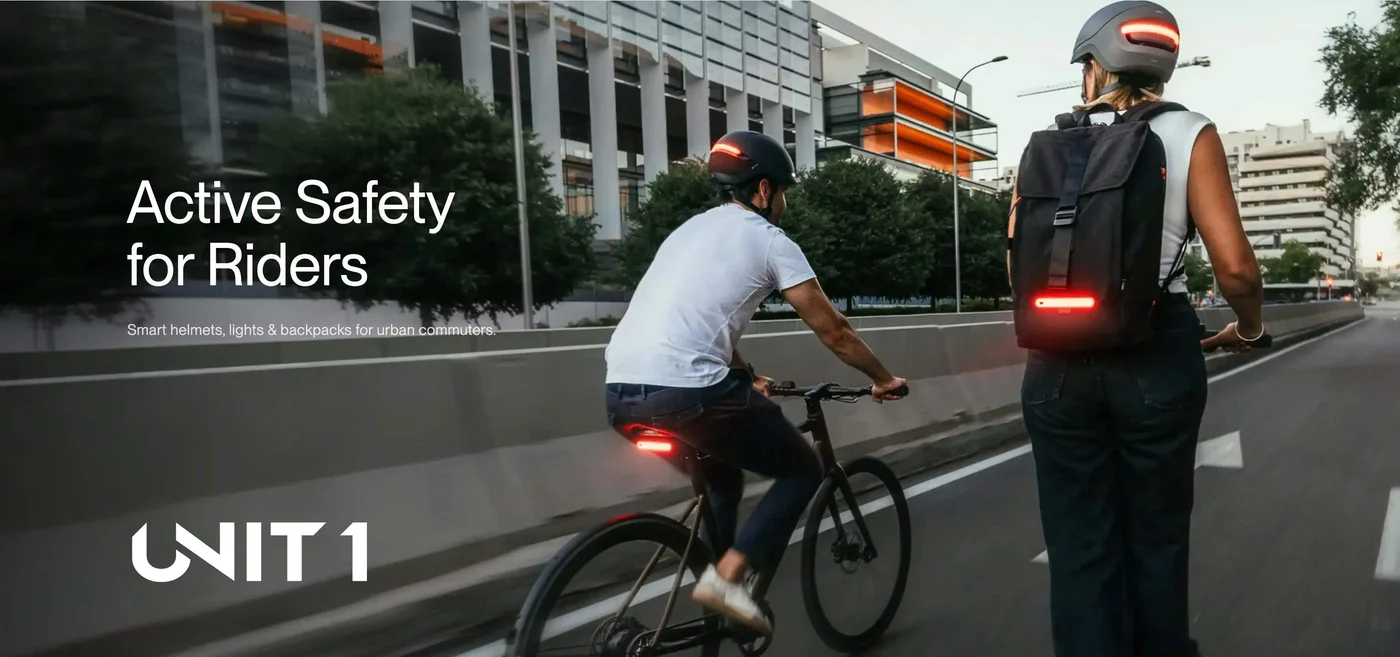
The UNIT 1 AURA Mips takes this approach quite seriously. Instead of treating lights as an accessory that happens to sit on a helmet, the AURA incorporates front and rear lighting into its design. UNIT 1 also supports turn signals and automatic brake lights when the helmet is paired with the company’s Remote.
There is another important distinction with the AURA: it is designed with higher-speed e-bike riding in mind. UNIT 1 lists NTA 8776 certification alongside EN 1078 and CPSC certification for the AURA. NTA 8776 is a standard specifically associated with helmets for higher-speed e-bike riding.
For commuters using an e-bike as their main transportation, that is a particularly relevant specification to investigate.
A recreational ride and a daily commute can expose a cyclist to very different conditions.
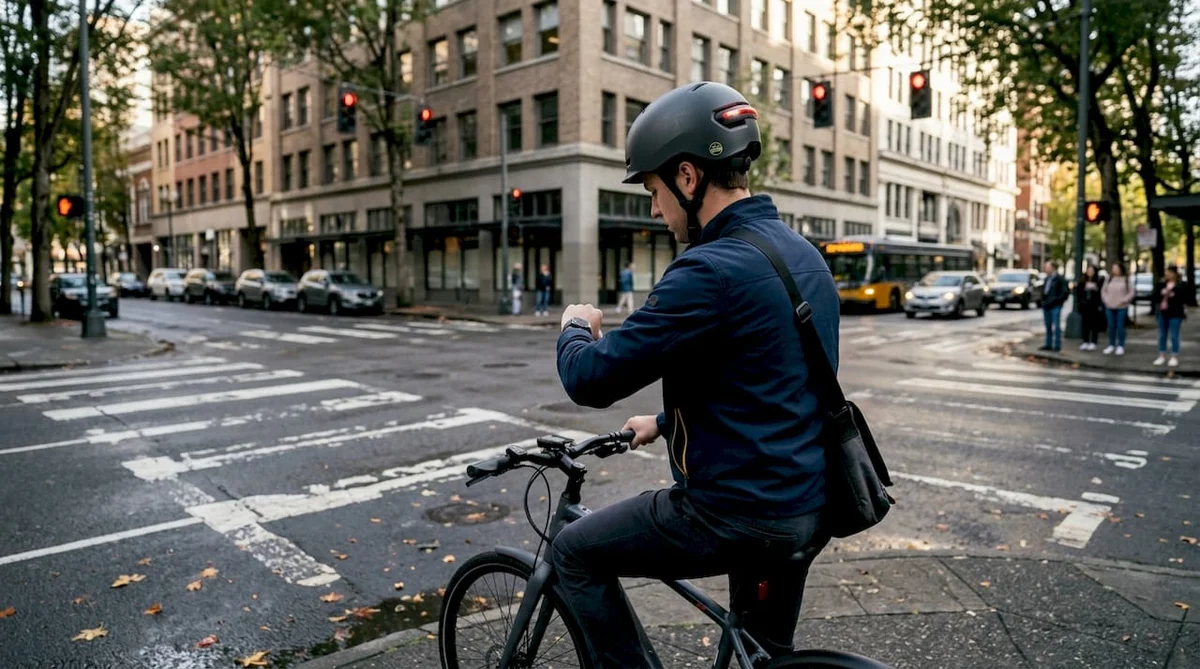
A weekend rider might be able to choose a route based on low traffic and good weather. A commuter often has less flexibility. The ride may happen before sunrise, after sunset, during a busy rush hour or on roads shared with cars, buses and trucks.
Visibility therefore becomes an important part of the equipment conversation.
That does not mean a light on a helmet makes a cyclist immune to traffic risks. It does mean that additional lighting can be useful when riding in conditions where being visible is important.
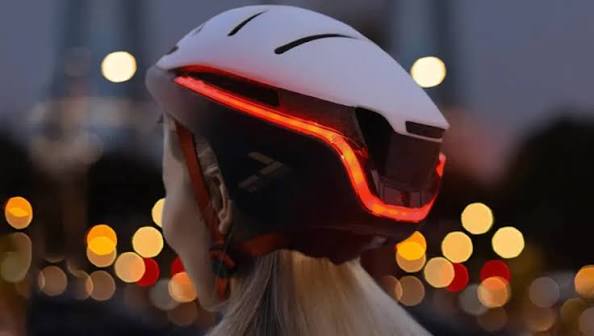
The AURA approaches visibility from several directions. It has integrated front and rear lights, while the turn-signal and brake-light functions can be used through the UNIT 1 Remote. UNIT 1 says the AURA has 360-degree lighting designed to improve visibility from different directions.
For someone commuting through an urban environment, that can be more convenient than remembering to charge and attach several separate accessories before leaving home.
The AURA Mips is built around several features rather than one single selling point.
The first is protection. The helmet incorporates MIPS, a low-friction layer designed to help reduce rotational motion transferred to the head during certain angled impacts.
The second is certification. UNIT 1 lists the AURA as meeting NTA 8776, EN 1078 and CPSC standards.
The third is visibility. There are integrated front and rear lights rather than a separate clip-on lighting system.
Then there are the smart features. A compatible UNIT 1 Remote can control turn signals and braking lights, while Crash Alert can detect a hard impact and, if the rider does not respond to the safety check, send an SOS with location information to an emergency contact through the UNIT 1 app.
The helmet can also connect to the UNIT 1 app using Bluetooth 5.0. The company lists app functions including Crash Alert, customizable lights, weather mode, battery tracking and battery-saving functionality.
In other words, the AURA is not simply a normal helmet with an LED stuck onto the back.
MIPS is one of the features that deserves attention because it is easy to misunderstand.
MIPS stands for Multi-directional Impact Protection System. The system is designed around the fact that some impacts happen at an angle rather than straight on.
UNIT 1 describes the MIPS layer in the AURA as a low-friction layer that can allow some movement between the helmet and the head during an angled impact, with the aim of reducing rotational motion transferred to the head.
That does not mean MIPS makes a helmet crash-proof. No bicycle helmet can eliminate every possible injury risk. The practical takeaway is that MIPS is an additional design element to consider when comparing helmets.
For commuters who are already looking beyond a basic helmet, having MIPS built into the AURA is one of the reasons the product belongs in the conversation.
UNIT 1 also says AURA has received a five-star safety rating from Virginia Tech’s Helmet Lab. Virginia Tech conducts helmet testing that includes different impact locations and impact conditions. UNIT 1 currently presents the AURA as a five-star-rated urban smart helmet.
That is different from a manufacturer simply saying that its helmet is safe. The Virginia Tech result is based on independent testing, although shoppers should still look at the testing methodology and remember that laboratory ratings cannot predict every real-world crash.
E-bike commuting is one area where the AURA Mips becomes particularly interesting.
E-bikes can be used for exactly the same kind of trip as a conventional bicycle, but many models allow riders to travel at higher speeds with less physical effort. That changes the way some riders think about equipment.
UNIT 1 lists NTA 8776 certification for the AURA. The company describes the standard as an e-bike certification for higher-speed riding and says the AURA is certified for e-bike use.
For US riders, it is worth remembering that helmet requirements can vary depending on the state, city, age of the rider and type of e-bike. Certification and local legal requirements are not necessarily the same thing.
So if you are buying an AURA for an e-bike commute, check the rules that apply to your particular location and e-bike class.
From a product perspective, though, having NTA 8776 alongside CPSC and EN 1078 gives the AURA a broad certification profile.
One of the first things you notice about a smart helmet is usually the lighting.
The AURA has integrated lights at both the front and rear. UNIT 1 lists a combined 350-lumen output for the front and rear lighting system.
That is useful because commuters do not always ride during bright daylight.
A morning commute in winter can begin in darkness. An evening trip can finish after sunset. A sudden change in weather can reduce visibility. Even if your route contains dedicated bike infrastructure, visibility remains relevant around intersections and road crossings.
The advantage of integrated lighting is convenience.
There is one less accessory to attach to the bike. There is also less chance of leaving the rear light sitting on your desk at home.
The AURA offers multiple lighting modes, and UNIT 1 lists Standard, Max Visibility and Eco modes on its current product information. The company also lists different potential battery runtimes depending on the lighting mode and brightness.
Those numbers are useful when planning a commute, but actual battery life will depend on how the helmet is configured and used.
Turn signals are another feature that separates the AURA from a traditional bike helmet.
The AURA supports turn signals when paired with the UNIT 1 Remote. The Remote is designed to let riders control signals without taking their hands away from the handlebars.
For someone who spends most of their riding time on roads with motor vehicles, the idea is easy to understand.
A cyclist can make a hand signal, but there are situations where a dedicated light indicator can provide another visual cue. The AURA’s turn signals are intended to communicate the rider’s direction to surrounding road users.
There is an important practical detail here: the Remote is sold separately. The basic AURA helmet includes the integrated lighting system, but the turn-signal functionality depends on the compatible Remote.
That is worth knowing before ordering because the total cost of a fully equipped setup is higher than the price of the helmet alone.

The AURA also supports automatic brake-light functionality.
According to UNIT 1, the automatic brake light activates when the rider slows down, helping communicate deceleration to other road users. This function is available through the UNIT 1 Remote.
It is an interesting feature because slowing down is not something a cyclist normally announces with a conventional bicycle light.
Again, it should not be viewed as a substitute for paying attention to traffic or riding defensively. It is another communication tool built into the helmet’s smart system.
For a commuter who frequently stops at intersections, traffic lights and busy crossings, that additional visual information can make sense as part of a larger visibility setup.
One of the more unusual features of the AURA Mips is Crash Alert.
UNIT 1 says the helmet uses sensors to detect a hard impact. If a crash is detected and the rider does not respond to the subsequent safety check, the system can send an SOS containing the rider’s location to an emergency contact through the UNIT 1 app.
This is not the same thing as having emergency services automatically dispatched to every crash. The feature relies on the helmet detecting a hard impact, the rider not responding to the safety check and the connected system functioning as intended.
That distinction matters.
Still, for people who regularly commute alone, especially early in the morning or later in the evening, an automated emergency-contact feature is an interesting addition.
It is also one of the features that shows why smart helmets are becoming a separate category rather than simply a variation on conventional cycling helmets.
Technology does not compensate for a poor fit.
The AURA Mips is available in three sizes: Small, Medium and Large. UNIT 1’s current size chart lists different head-circumference ranges depending on whether the rider has an oval or round head shape.
For an oval head shape, UNIT 1 lists:
Small: 20.1–21.7 inches
Medium: 21.7–23.8 inches
Large: 23.8–24.8 inches
For a round head shape, the listed ranges are:
Small: 20.1–21.3 inches
Medium: 21.3–23.2 inches
Large: 23.2–24.2 inches.
UNIT 1 recommends choosing the larger size if you fall between sizes.
The company also explains that head measurement should be taken around the head just above the eyebrows and around the widest part at the back.
That is a small step, but it is one of the most important things to do before buying any helmet online.
Do not choose a size simply because you normally wear a certain hat size. Measure your head and compare it with the manufacturer’s chart.
UNIT 1 lists the AURA at 440 grams in Medium.
That is not an ultra-minimalist road-racing helmet, but it is important to consider what is included in that weight.
The helmet contains integrated front and rear lighting, electronics, a battery, sensors and the MIPS system. It also has the hardware needed for its connected functionality.
UNIT 1 lists an EPS impact-absorbing layer and polycarbonate hard shell, along with polyester comfort padding.
The helmet also uses a FIDLOCK magnetic buckle and a magnetic attachable brim.
For a commuter, the trade-off is relatively straightforward: you are carrying more technology than you would in a minimalist conventional helmet, but you are also getting lighting and connected features integrated into the product.

Ventilation becomes especially important for people who commute regularly.
A helmet that looks impressive on a product page does not help much if the rider hates wearing it because it becomes uncomfortable during a warm ride.
UNIT 1 lists 10 fixed vents on the AURA: two at the front/sides, four on top and four at the rear.
The company also describes the AURA as designed for city and road riding, with ventilation intended to keep airflow moving while retaining its integrated lighting design.
This is one area where personal preference matters.
Someone riding five miles through a city at moderate speed may have very different comfort requirements from a cyclist riding 25 miles on an exposed road in summer.
If your commute is long, try to pay attention not only to the number of vents but also to helmet fit, padding, hair, glasses and the conditions in which you normally ride.
Commuters cannot always choose perfect weather.
The AURA’s technical specifications list an IP67 rating for splash, water and dust resistance, with the rating described according to IEC 60529. UNIT 1 states that the helmet is protected from dust and water-resistant up to one metre for 30 minutes under the conditions of that rating.
UNIT 1’s broader smart-helmet information also states that its helmets, lights and Navigation Remote are waterproof.
Even so, riders should follow the manufacturer’s care and charging instructions rather than treating an electronics-equipped helmet like something that can be submerged without concern.
Weather resistance is particularly useful for commuters because a helmet can encounter much more than the occasional sunny weekend ride.
The AURA is not completely standalone.
UNIT 1 says the helmet connects to the UNIT 1 app using Bluetooth 5.0. The company lists features including Crash Alert, customizable lighting, weather mode, battery tracking and battery-saving mode.
That connected approach is one reason to think about the AURA as an ecosystem rather than only a helmet.
For some riders, this will be a benefit. Being able to customize features and monitor battery information from a phone can make sense.
For others, it may feel like more technology than they want in their cycling gear.
That is probably one of the biggest questions to ask yourself before buying a smart helmet: do you actually want the connected features?
If the answer is no, a conventional helmet and separate bike lights may be a simpler solution.
If you want integrated lighting, smart controls and crash-alert functionality, the AURA becomes much more interesting.
A conventional commuter helmet can still do its job without an app, battery or electronics.
That simplicity is a legitimate advantage.
You put it on, adjust the fit and ride.
The AURA takes a different approach. It adds integrated lighting, MIPS, e-bike certification, smart controls and Crash Alert.
The comparison therefore is not simply about which helmet has more features.
It is about whether those features are useful to you.
If your commute is a short trip on quiet streets during daylight, the extra technology may not be necessary.
If you commute before sunrise, regularly ride after dark, use an e-bike, travel through busy intersections and want integrated visibility features, the additional functionality could be more relevant.
That is the real reason the AURA stands out. It attempts to bring several pieces of commuting equipment into one system.

The AURA is particularly well suited to the conversation around e-bike commuting because UNIT 1 has built its feature set around higher-speed riding.
The NTA 8776 certification is one part of that. MIPS is another. Integrated lights address visibility, while the optional Remote adds turn signals and automatic brake-light functionality. Crash Alert adds another layer of connected safety functionality.
None of those features eliminates the need for responsible riding.
You still need to follow local traffic laws, use appropriate bike infrastructure where available, maintain your e-bike and pay attention to surrounding traffic.
But the equipment can support the way a commuter actually rides.
That is where a smart helmet can make more sense than buying technology simply because it sounds impressive.
For a US commuter who wants a basic helmet, the AURA may be more technology than necessary.
But for someone specifically looking for a smart helmet, its feature set is compelling.
You get MIPS protection, NTA 8776 e-bike certification, CPSC and EN 1078 certification, integrated front and rear lighting, app connectivity and Crash Alert. The Remote adds turn signals and automatic brake lights.
The AURA also has a practical hybrid design. UNIT 1 describes it as suitable for city and road riding rather than limiting it to one type of cycling.
That makes it an option for someone whose weekday commute turns into a longer weekend ride.
UNIT 1’s current US product page lists the AURA Mips at $260 for the helmet alone, although prices and promotions can change. The company also offers bundles containing combinations of the helmet, Remote, visor and Smart Light products.
For example, the current product page lists a Ride Pack, Premium Pack, Ultimate Pack and Commuter Pack in addition to the helmet-only option. The exact contents and prices should be checked directly before ordering because promotions and availability can change.
This is an important consideration.
If you only want the helmet and its built-in lights, the helmet-only option may be enough.
If turn signals are a priority, you need to factor the Remote into your budget.
If you want additional synchronized lighting or a visor, the bundle options may make more sense depending on what you actually need.
The AURA can also be configured with a magnetic visor.
UNIT 1 currently lists clear, tinted and adaptive visor options. The company describes the clear visor as suitable for lower-light conditions and the tinted version as suited to sunny conditions, while the adaptive option is intended for changing weather conditions. The visors use a magnetic attachment system.
This gives the helmet a little more flexibility for riders who spend time outside the city or want additional wind and sun protection.
The visor should not be viewed as essential for every commuter, though.
If most of your riding happens on short urban trips at moderate speeds, you may prefer the open configuration.

The AURA Mips makes the most sense for riders who want several features in one helmet.
It is particularly relevant to:
Daily e-bike commuters who want a helmet certified for higher-speed e-bike riding.
Cyclists who regularly ride in traffic and want integrated front and rear lighting.
Riders who commute early in the morning or after sunset.
People interested in MIPS protection.
Commuters who want turn signals and automatic brake lights through a handlebar remote.
Riders who want a crash-alert feature connected to emergency contacts.
Cyclists who want one helmet that can move between urban commuting and longer road rides.
That does not mean every person in these groups needs an AURA. Helmet choice remains personal, and fit should always be one of the first considerations.
There are also riders for whom the AURA’s technology may not be necessary.
If you mostly ride short distances during daylight, already have excellent bike lights and prefer equipment without apps or batteries, a conventional helmet could be perfectly adequate for your needs.
There is nothing wrong with choosing simplicity.
The AURA’s value comes from combining several functions. If you do not intend to use those functions, paying for them may not make sense.
The product is therefore better understood as a smart commuting system than as simply a more expensive version of a standard helmet.
Once you have selected the correct size, the next step is getting the helmet ready for your actual routine.
Start by making sure the fit is secure and comfortable. The helmet should not move excessively when you turn your head.
Then charge the helmet according to UNIT 1’s instructions and familiarize yourself with the lighting controls.
If you have the Remote, learn how the turn signals and braking functionality operate before using them in busy traffic.
Connect the helmet to the UNIT 1 app and review the available settings.
If you plan to use Crash Alert, configure the appropriate emergency-contact information and understand how the safety check works.
It is also worth doing a short test ride somewhere familiar.
That gives you the opportunity to learn the controls without trying to figure them out for the first time at a complicated intersection.
The integrated lights are one of the AURA’s most practical features for commuters.
Imagine leaving home at 6:30 in the morning during winter. It may still be dark. Later, you finish work and ride home after sunset.
Instead of remembering to attach a front light and rear light every day, the lighting system is already integrated into your helmet.
UNIT 1 lists different light modes and battery runtimes, so it is worth choosing a mode appropriate to your commute and checking the battery regularly.
The important point is consistency.
A light that is integrated into something you already wear can be easier to remember than an accessory that has to be mounted separately.
Although the AURA is strongly suited to urban commuting, UNIT 1 does not position it exclusively as a city helmet.
The company describes the AURA as a hybrid helmet intended for city and road riding.
That can be useful if your cycling routine changes depending on the day.
Monday through Friday might mean commuting through traffic.
Saturday could mean a longer road ride.
Sunday might involve an e-bike trip to a café or park.
Instead of maintaining different helmets for different types of riding, some riders may prefer the flexibility of a hybrid design.
The best smart bike helmet is not necessarily the one with the longest feature list.
It is the one whose features make sense for the way you actually ride.
The UNIT 1 AURA Mips has a clear focus: combine helmet protection, e-bike certification, visibility and connected safety technology into one piece of equipment.
Its specifications include MIPS protection, NTA 8776, CPSC and EN 1078 certifications, integrated front and rear lights, Bluetooth 5.0 connectivity, Crash Alert, customizable lighting and support for turn signals and automatic brake lights through the UNIT 1 Remote.
UNIT 1 also states that AURA has received a five-star rating from Virginia Tech’s Helmet Lab, giving shoppers another independently tested data point to consider when researching the helmet.
The trade-off is that the AURA is more complex and more expensive than a basic bicycle helmet. You are buying into an ecosystem that includes the helmet, app and optional accessories.
For a commuter who wants nothing more than basic head protection, that may be unnecessary.
For a rider who wants integrated visibility, MIPS, e-bike certification, connected features and crash-alert functionality in one helmet, the AURA Mips is a product worth researching.
The most important step before buying is still the simplest one: make sure it fits.
After that, think about how you actually commute. Do you ride after dark? Do you use an e-bike? Do you spend time around heavy traffic? Would integrated lights be more convenient than separate lights? Would turn signals or Crash Alert be useful to you?
If the answers point toward a more connected approach to cycling, the UNIT 1 AURA Mips has a feature set specifically built around that kind of rider.
You can check the latest AURA Mips specifications, available sizes, colors, accessories and current pricing directly from UNIT 1 before making a purchase.