

E-bike commuting has changed what getting around a city looks like. Instead of sitting in traffic, waiting for a train, or making a short trip in a car, more riders are choosing two wheels for the daily journey to work, school, appointments, shops, and other destinations.
That convenience comes with a different set of challenges.
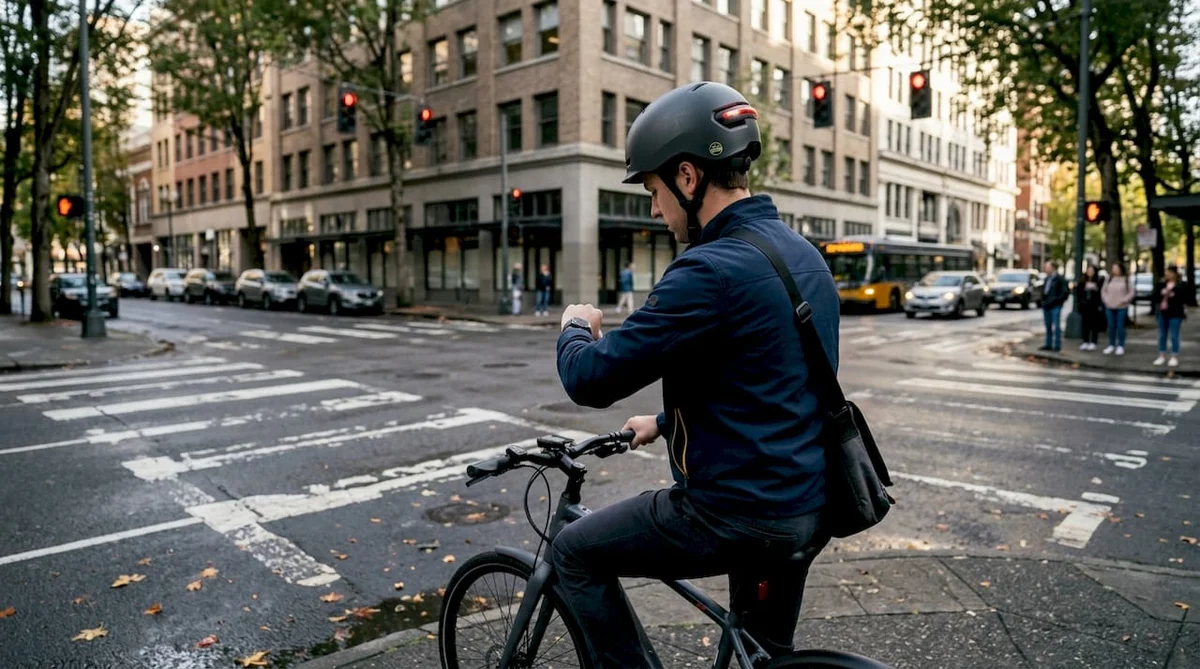
A commuter on an e-bike may spend part of the ride on a protected bike lane, part on a busy city street, and another section navigating intersections, parked cars, pedestrians, buses, delivery vehicles, and other cyclists. In New York, Chicago, and San Francisco, the urban environment can change dramatically from one block to the next.
That is why a helmet for e-bike commuting needs to do more than simply sit on your head.
Traditional helmets remain an important part of cycling safety because their primary job is protecting the rider’s head during an impact. But modern smart helmets add another layer of technology around that basic function. Integrated lights can make a rider easier to notice, turn signals can communicate an intended direction, brake lights can indicate deceleration, and crash-alert technology can provide assistance when a rider may be unable to call for help.
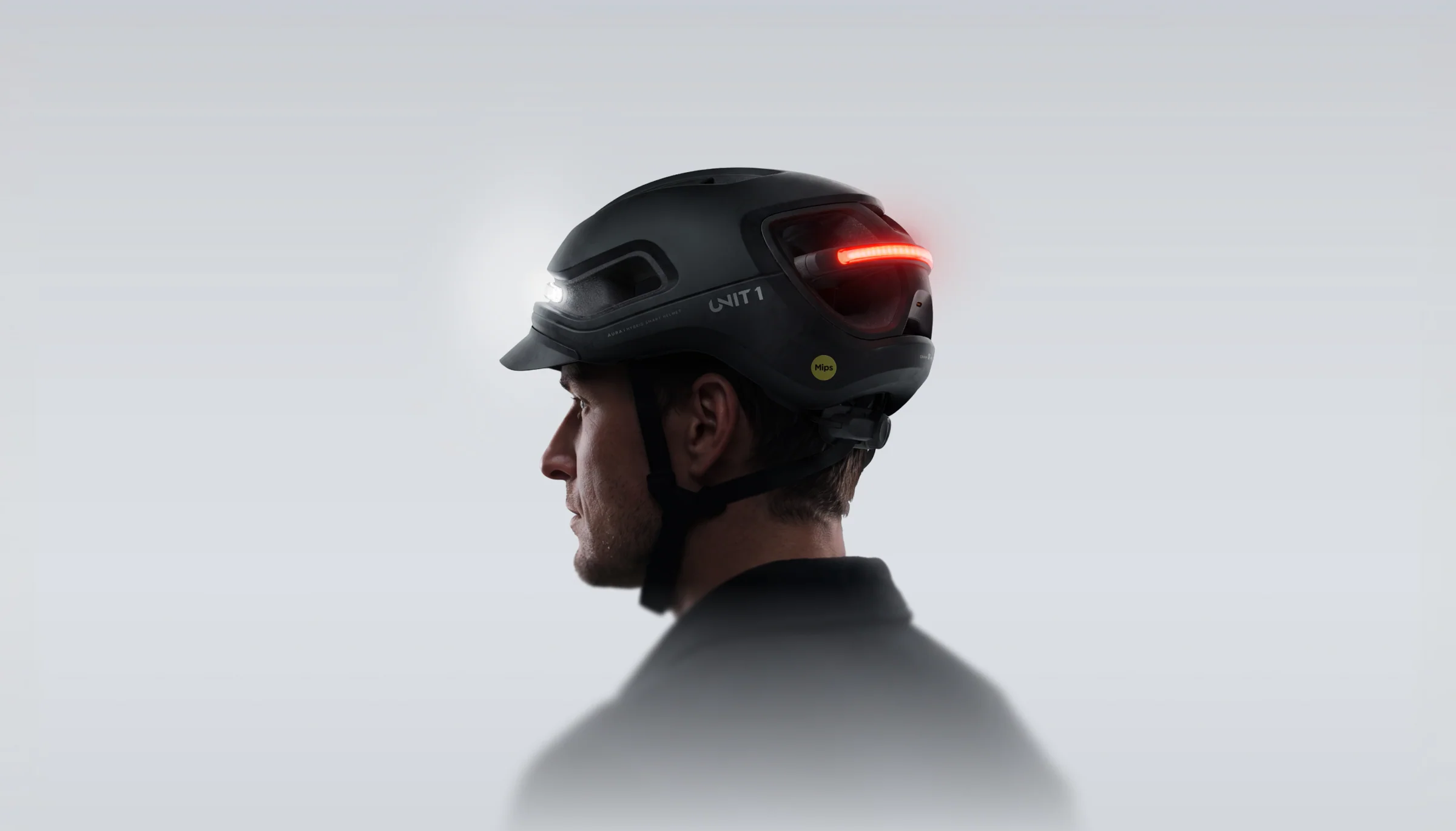
The UNIT 1 AURA Mips is one example of this approach. UNIT 1 describes AURA as an e-bike-certified smart helmet with Mips protection, integrated front and rear lights, turn signals, automatic brake lights, and Crash Alert. The helmet is certified to NTA 8776, EN 1078, and CPSC standards, according to the company’s product information.
For someone commuting by e-bike every day, those features can make sense because they address two different parts of riding: what happens before a crash and what happens if one occurs.

A recreational bike ride and a daily urban commute may use the same basic equipment, but they are very different experiences.
A weekend rider might spend an hour on a quiet trail. A commuter could leave home before sunrise, ride through traffic, cross several major intersections, stop frequently, and arrive at work with another trip waiting at the end of the day.
The environment is unpredictable.
New York has dense traffic and busy intersections. Chicago has a mixture of protected lanes, road traffic, and changing weather conditions. San Francisco combines dense urban traffic with hills, varied road surfaces, and frequent changes in elevation.
An e-bike can also make it easier to cover longer distances without arriving exhausted. That is one of the reasons electric bicycles have become useful transportation tools rather than simply recreational products.
But an e-bike’s convenience does not remove the need to think about visibility and protection.
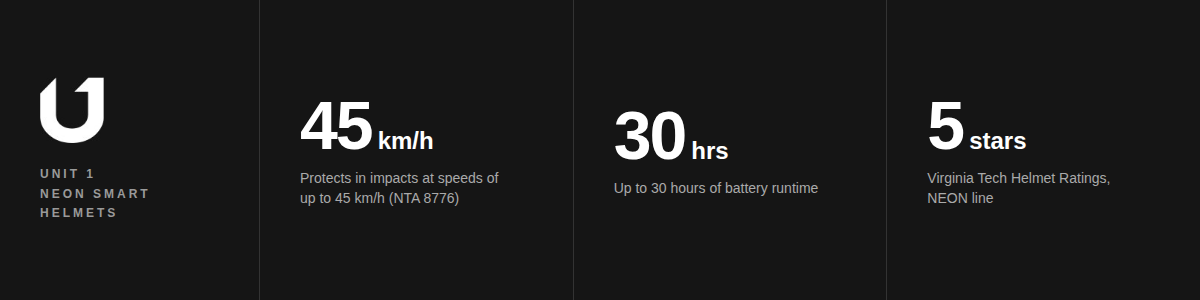
In fact, the combination of higher speeds and mixed traffic makes those considerations particularly relevant. UNIT 1 specifically markets AURA as an e-bike-certified helmet and says NTA 8776 is intended for higher-speed e-bike riding. The company lists AURA as protected up to 45 km/h, or about 28 mph, on its product pages.
That does not mean a helmet makes an e-bike ride risk-free. It does mean commuters have another reason to pay attention to the equipment they use every day.
One of the first things to check when shopping for an e-bike helmet is certification.
It can be easy to focus on appearance, ventilation, lights, Bluetooth connectivity, or other features before checking whether the helmet is actually certified for the type of riding you intend to do.
UNIT 1 says AURA is certified to NTA 8776, EN 1078, and CPSC standards. Its product information also describes the helmet as e-bike certified.
NTA 8776 is particularly relevant to higher-speed electric bicycles. UNIT 1 explains that the standard was developed around the higher speeds associated with speed pedelecs and electric bicycles and says its AURA helmet is tested under this standard.
For an e-bike commuter, this is worth understanding because not every helmet is marketed or tested in exactly the same way.
The important point is simple: look beyond the word “bike helmet” and check the actual certifications listed by the manufacturer.
Certification does not mean a helmet can prevent every injury. No helmet can promise that. It means the product has been tested against applicable requirements under the relevant standard.
That is a much more useful starting point than choosing a helmet solely because it looks good.
Another term that appears frequently when shopping for cycling helmets is Mips.
Mips stands for Multi-directional Impact Protection System. It is designed to address rotational motion that can occur during certain angled impacts.
UNIT 1 describes the Mips system in its AURA materials as a low-friction layer intended to help reduce rotational motion transferred to the head. The AURA product is specifically identified as an AURA Mips smart helmet.
This matters because not every cycling crash involves a perfectly straight impact.
A rider can fall at an angle, slide, hit an obstacle, or make contact with the ground in a way that involves both linear and rotational forces. Mips technology is intended to address that rotational component.
It should not be treated as a replacement for proper riding technique, appropriate speed, or other safety measures. It is simply one part of the helmet’s overall design.
For an e-bike commuter who spends every weekday riding through traffic, having a helmet that combines e-bike certification with Mips protection can be an attractive combination.
Visibility is one of the biggest reasons to consider a smart helmet.
A commuter can be wearing a perfectly fitted helmet and still be difficult for other road users to notice, particularly during early-morning rides, evening commutes, poor weather, or darker sections of a route.
This is where built-in lighting becomes interesting.
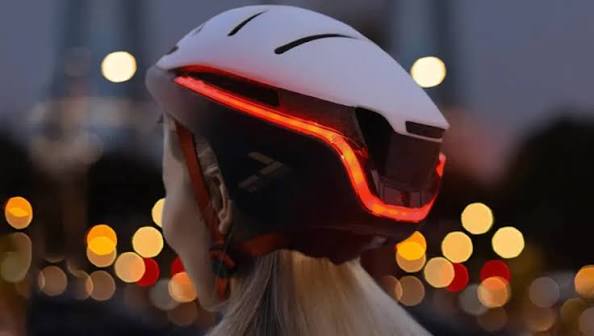
AURA has integrated front and rear lights, and UNIT 1 describes the system as providing visibility from all directions during both day and night. The company lists a 350-lumen output for the helmet’s lights.
The advantage of having lights integrated into the helmet is convenience.
There is one less separate device to remember to attach before leaving home.
There is also a practical visibility benefit to placing lighting higher on the rider. A helmet light sits above the bicycle frame and can remain visible in situations where a lower-mounted light may be partially obscured by vehicles, bags, or other objects.
Of course, an integrated helmet light should not automatically be treated as a complete replacement for every bicycle light required or recommended for a particular ride. Riders should still consider the lighting on their bicycle and follow applicable local requirements.
The bigger point is that visibility should be part of the commuting setup, not an afterthought.
New York is an obvious example of why visibility matters.
A typical e-bike commute can involve bike lanes, intersections, parked vehicles, buses, pedestrians, taxis, delivery vehicles, and other cyclists in a relatively short distance.
The challenge is not necessarily riding quickly. It is making your movements understandable to everyone around you.
If a rider needs to turn, slow down, or stop, communication becomes important.
AURA’s lighting system is designed around this idea. UNIT 1 says the helmet supports turn signals and automatic brake lights. With the UNIT 1 Remote, riders can control turn signals without removing their hands from the handlebars, while automatic brake lights can activate when the rider slows down. The Remote is sold separately.
For an urban commuter, that can be more useful than simply having a bright light.
A light tells other people where you are.
A turn signal can help communicate where you are going.
A brake light can communicate that you are slowing down.
Those are different pieces of information.
Cyclists traditionally communicate turns using hand signals.
Those signals remain useful, but there are moments when a rider may prefer to keep both hands on the handlebars, particularly in complicated traffic or while controlling an e-bike.
The AURA system provides another option through its compatible Remote.
UNIT 1 says the Remote allows riders to control turn signals from the handlebars without letting go.
The idea is not to replace awareness or hand signals in every situation. Instead, it adds another method of communicating intentions.
Imagine approaching an intersection in Manhattan or another busy urban area. You are watching vehicles, checking the lane ahead, monitoring pedestrians, and preparing for the turn.
Having a handlebar-mounted control for the helmet’s turn signals can make the lighting system easier to use as part of your normal riding routine.
The important detail is that the Remote is an additional component. The basic AURA helmet itself has integrated lighting, while the turn-signal and automatic-brake-light functions are part of the broader UNIT 1 system and compatible Remote setup.
That distinction is worth knowing before buying.
Chicago presents another interesting environment for e-bike commuters.
A daily rider may deal with changing light conditions, busy streets, bike lanes, intersections, parked vehicles, pedestrians, and weather that can change significantly throughout the year.
For commuters, this means a helmet needs to be practical enough to use regularly.
The best safety feature is not particularly useful if it is too inconvenient to use every morning.
This is one area where an integrated system can have an advantage. AURA’s front and rear lights are part of the helmet rather than something that needs to be mounted separately each time. UNIT 1 also provides different lighting modes through the helmet and app.
The company lists Standard, Max Visibility, and Eco light modes on its AURA product page. The app can also be used to control lighting and track battery information.
For a commuter, that can make the difference between a feature that sounds impressive and one that actually becomes part of the daily routine.

Brake lights are familiar on cars, motorcycles, and many other road vehicles.
Cyclists generally do not have the same type of automatic brake-light system.
UNIT 1’s AURA is designed to provide automatic brake-light functionality. According to UNIT 1, the system can automatically signal deceleration, and the braking behavior can be configured through the app.
That is particularly relevant in traffic.
When a cyclist suddenly slows, the rider behind may not immediately know why. A visible rear brake indication provides another visual cue.
It is not a substitute for riding predictably. A commuter still needs to slow gradually when possible, pay attention to traffic, and use appropriate signals.
But having another way to communicate a change in speed can be useful.
San Francisco brings another consideration to e-bike commuting: hills.
A route that looks short on a map may involve substantial elevation changes. E-bikes make those routes more manageable, but downhill sections can introduce a different riding experience from a flat commute.
Speed can increase quickly on descents.
That makes preparation particularly important.
A helmet with an e-bike-focused certification, Mips protection, and visibility features can be appealing for riders who regularly travel through changing terrain and traffic conditions.
AURA is designed for both city and road riding, according to UNIT 1, and the company lists 14 vents, removable internal pads, and a weight of 440 grams for the helmet.
Ventilation matters when climbing hills, particularly if the rider is pedaling hard.
It also matters during longer commutes when the helmet may be worn for a significant amount of time.
Lighting is primarily about what happens before a collision.
Crash Alert addresses what may happen afterward.
This is one of the most interesting features of the AURA system.
UNIT 1 says AURA uses accelerometers and sensors to detect a hard crash. The helmet then issues a safety countdown through the UNIT 1 app. If the rider does not respond, the system sends an SMS with the rider’s location to an emergency contact.
That does not mean the helmet automatically contacts emergency services.
The feature works through the app and an emergency contact, and the rider needs the relevant system setup for it to function.
That distinction matters.
Still, consider the situation it is designed to address.
A rider may crash while commuting alone. They may be shaken, injured, or temporarily unable to use their phone.
In such a situation, having a system that can detect a hard crash, provide a chance to cancel the alert, and send location information to a designated emergency contact can provide an additional layer of support.
It is not a guarantee of assistance. It is a backup mechanism.
Many commuters ride alone.
That means there may not be another cyclist immediately available to notice a crash.
The rider might fall on a quieter section of a route, during an early morning commute, or at a time when there are fewer people nearby.
A phone can obviously be used to contact someone, but reaching it may not always be practical after a hard fall.
This is where Crash Alert becomes a different type of feature from lighting.
Integrated lights help other people see you.
Crash Alert is intended to help communicate that something may have happened when you cannot respond.
UNIT 1’s AURA system gives the rider a countdown before the alert is sent, which provides an opportunity to indicate that they are okay rather than automatically sending the message after every detected incident.
That approach makes sense for a system designed to detect crashes rather than ordinary stops or falls.

A smart helmet is not simply a conventional helmet with a few LEDs attached.
The software is an important part of the overall experience.
UNIT 1 says AURA connects to the UNIT 1 app through Bluetooth 5.0. The app can be used for lighting customization, weather mode, battery tracking, battery-saving functions, Crash Alert, and synchronization with the UNIT 1 Remote and compatible Smart Lights.
The company also describes the app as the central place for controlling different aspects of the helmet and connected equipment.
This is useful for commuters because a daily-use product benefits from simple controls.
You do not want to spend five minutes configuring your helmet before every trip.
Ideally, the setup happens once, and the equipment becomes part of the routine.
Any helmet with electronics introduces one issue that a basic helmet does not have: battery management.
A conventional helmet does not need to be charged.
A smart helmet does.
According to UNIT 1’s current AURA product information, the helmet uses a 1350mAh battery. The company lists different estimated runtimes depending on the lighting mode and brightness, including up to three hours in Solid mode at 100% brightness and longer runtimes in Beacon mode at lower brightness.
Actual battery life depends on how the helmet is used.
Someone commuting for 20 minutes each way may have a very different charging routine from someone riding for several hours.
This is why commuters should think about charging just as they think about charging their e-bike.
A smart helmet is most useful when it is charged and ready before the ride.
Technology can sometimes make cycling equipment look more complicated than it needs to be.
A commuter helmet still has to be comfortable enough to wear.
UNIT 1 lists AURA with three sizes, removable internal pads, ventilation, a magnetic buckle, and a magnetic brim. The product page lists the medium helmet weight at approximately 440 grams.
The company describes the helmet as having 14 vents on its AURA information page, while its detailed product specification lists 10 fixed vents divided between front/sides, top, and rear.
For commuters, fit remains one of the most important considerations.
A helmet can have excellent technology, but it still needs to fit correctly.
Before buying, measure your head and use the manufacturer’s sizing information. UNIT 1 offers Small, Medium, and Large sizing for AURA.
A good fit should be treated as essential, not optional.
One of the less dramatic AURA features is the magnetic buckle.
UNIT 1 says AURA uses a FIDLOCK magnetic buckle that can be operated with one hand.
This may sound minor compared with crash detection and integrated lights, but small details become important when a product is used every day.
Commuters often put their helmet on while carrying a bag, holding a coffee, preparing a bicycle, or getting ready for work.
A buckle that is easy to operate can make the daily routine less frustrating.
Of course, the buckle does not replace the need to properly secure the helmet.
Night riding is one of the situations where integrated lighting becomes particularly relevant.
The front light helps provide visibility from the front, while the rear light provides visibility from behind.
UNIT 1 describes AURA’s lighting system as 360-degree integrated lighting and says the front and rear lights are intended to help keep the rider visible day and night.
For commuters, the benefit is that visibility is built into something they are already expected to wear.
A rider still needs to think about bicycle lighting, reflective clothing when appropriate, road conditions, and the laws or recommendations that apply to their location.
The helmet should be considered part of a larger visibility strategy.
Urban cycling rarely happens under perfectly controlled conditions.
A morning can begin clear and end with rain. A commute can move from sunlight into shadow and back again. Winter darkness can arrive before the workday is finished.
AURA’s product specifications list the helmet as IP67 rated for protection against dust and water resistance up to one meter for 30 minutes according to IEC 60529.
That is useful information for anyone considering a smart helmet, because electronics and water resistance are important considerations.
It is still sensible to follow the manufacturer’s care instructions rather than assuming that an IP rating means the helmet can be treated like underwater equipment.
Not necessarily.
A smart helmet costs more than a basic helmet because it includes additional hardware, electronics, lighting, sensors, and software.
The AURA Mips is currently listed by UNIT 1 at $260 for the helmet alone on its product page, although prices and promotions can change. The same page lists packages that include the Remote and other accessories.
So the question is not simply whether a smart helmet is “better.”
The more useful question is whether the features solve problems that matter to you.
If your e-bike commute is short, takes place during daylight, and happens mostly on quiet paths, you may place more emphasis on basic protection, fit, ventilation, and price.
If you commute through dense traffic, ride early in the morning or after dark, travel longer distances, or regularly ride alone, features such as integrated lighting, turn signals, brake lights, and Crash Alert may become more attractive.
The main appeal of AURA is that its features work together rather than existing as completely separate accessories.
The helmet provides the protective foundation.
Mips adds a low-friction layer intended to address rotational forces.
NTA 8776 certification addresses higher-speed e-bike use.
Front and rear integrated lights improve visibility.
Turn signals can communicate direction when used with the compatible Remote.
Automatic brake lights can indicate deceleration.
Crash Alert adds an emergency-contact feature after a detected hard crash.
The UNIT 1 app ties many of these functions together.
UNIT 1 currently describes AURA as its hybrid smart helmet for city and road use and lists front and rear lighting, turn signals, automatic brake lights, Crash Alert, and e-bike certification among its features.
That combination is what makes it different from a standard cycling helmet.
It is important not to expect too much from technology.
A smart helmet does not replace defensive riding.
It does not make a red light safe to run.
It does not make a distracted driver less dangerous.
It does not eliminate blind spots.
It does not make wet pavement harmless.
It does not replace bicycle maintenance.
And it does not mean a rider can stop paying attention.
The technology is best viewed as an additional layer.
A rider still needs to control speed, watch intersections, look for opening car doors, communicate intentions, obey applicable traffic rules, maintain the e-bike, and use appropriate lights and reflective equipment.
The helmet is part of the system, not the entire system.
For someone commuting regularly in New York, Chicago, or San Francisco, it helps to think about safety equipment as a complete setup.
Start with a properly fitted helmet.
Then consider visibility.
Use appropriate front and rear bicycle lighting and make sure the equipment is charged. If your helmet includes integrated lighting, use it rather than leaving it switched off because you forgot how to operate it.
Think about communication.
If your smart helmet supports turn signals, learn how they work before riding into heavy traffic. Practice using the controls so they become familiar.
Think about emergency preparation.
If you use Crash Alert, configure the app and emergency contact information before relying on the feature.
Finally, think about the route itself.
A smart helmet cannot tell you whether a particular road is appropriate for your skill level. Route planning remains important.
If you are comparing several helmets, there are a few practical questions worth asking.
First, what certifications does the helmet have?
Second, does it fit correctly?
Third, does it have the visibility features you will actually use?
Fourth, how does it handle charging and battery life?
Fifth, does it offer additional protection technology such as Mips?
Sixth, if it has crash detection, what exactly happens after a crash?
Seventh, does the feature require an app, smartphone connection, subscription, or separate accessory?
These questions can prevent disappointment after buying.
With AURA, for example, the core helmet includes integrated front and rear lights, while the Remote is a separate accessory used for functions such as turn signals and brake-light control. UNIT 1 also connects AURA to its mobile app for additional controls and features.
Knowing those details before ordering is much better than discovering them after the box arrives.
The strongest argument for a smart helmet is not any single feature.
It is the combination.
Consider a normal commute.
Before anything goes wrong, integrated lights help make you more noticeable.
As you approach a turn, the compatible Remote can control the helmet’s turn signals.
As you slow down, the automatic brake-light function can communicate deceleration.
If a hard crash occurs, Crash Alert can detect the incident, issue a countdown, and, if the rider does not respond, send location information to an emergency contact.
These features address different moments of the same journey.
That is the interesting part.
Instead of thinking about safety only as protection during an impact, a smart helmet expands the idea to include visibility and communication before the impact and emergency communication afterward.
The biggest difference between commuting and occasional riding is repetition.
If you ride five days a week, small inconveniences add up.
A separate light needs to be mounted.
A separate rear light needs to be charged.
A separate turn signal device may need to be remembered.
A phone needs to be accessible.
A traditional helmet only solves one part of the equation.
A smart helmet attempts to bring several functions together.
That does not automatically make it the right purchase for everyone, but it does explain why products such as the UNIT 1 AURA are attracting attention from urban riders.

E-bike commuting is about convenience, but a good commute also depends on preparation.
Whether you are riding through Manhattan, crossing Chicago neighborhoods, or climbing and descending San Francisco streets, the basic principles remain the same: wear a properly fitted helmet, make yourself visible, communicate your intentions, control your speed, and stay aware of the traffic around you.
A smart helmet adds technology to those fundamentals.
The UNIT 1 AURA Mips is designed around that idea. It combines Mips protection with NTA 8776, EN 1078, and CPSC certification, integrated front and rear lights, and a connected system that includes turn signals, automatic brake-light functionality, and Crash Alert.
Its Crash Alert feature is particularly interesting for riders who regularly commute alone. According to UNIT 1, AURA detects a hard crash using sensors and accelerometers, provides an in-app safety countdown, and can send an SMS containing the rider’s location to an emergency contact if the rider does not respond.
The built-in lighting is equally relevant to city commuting. Instead of treating visibility as an accessory that can be forgotten at home, AURA puts front and rear lights directly into the helmet. The compatible Remote adds another layer by allowing riders to control turn signals and related lighting functions from the handlebars.
That does not make a smart helmet a substitute for careful riding.
It simply gives commuters more tools.
For riders who spend a lot of time around traffic, ride during changing light conditions, and want their helmet to do more than provide passive protection, those tools can be worth considering.
And that is probably the best way to look at the UNIT 1 AURA: not as a magic solution to the risks of city cycling, but as a modern piece of riding equipment that combines protection, visibility, communication, and post-crash assistance in one connected system.
For a daily e-bike commuter, having those features available every time you leave home can be a practical upgrade from a basic helmet and a collection of separate accessories.
Before buying, however, check the latest product specifications, sizing information, pricing, included accessories, and applicable local cycling requirements. Product configurations and prices can change, and the manufacturer should always be the final source for current AURA specifications.