

Staying connected has become part of almost every trip. Whether you are checking directions in a new city, booking a ride, messaging family back home, looking up restaurant reviews, working remotely, or simply keeping your travel plans organized, having mobile data can make travelling much easier.
The problem is that choosing a travel eSIM is not always as straightforward as it sounds. There are different providers, different countries, different data allowances, and different validity periods. Even after choosing a provider, you may still have to decide how long your plan should last.
Maya Mobile takes a relatively simple approach. Its current global travel eSIM offering includes plans for different trip lengths, including 7-day, 14-day, and 30-day options. The plans are designed for travellers who want mobile data without relying on their regular carrier’s international roaming service.
So, which one should you choose?
The answer mainly comes down to the length of your trip and how much flexibility you want. A seven-day plan makes sense for a short holiday or city break. A 14-day plan can fit a typical two-week vacation, while a 30-day plan is aimed at longer trips, extended travel, and people who need connectivity for several weeks.
There is also another important point to understand before choosing. Maya Mobile currently describes its global plans as unlimited data plans, but its terms explain that each plan includes a daily high-speed data allowance. Once that allowance is used, data remains available at standard speed, and the high-speed allowance resets every 24 hours.

That detail matters when comparing the plans because “unlimited” does not mean unlimited high-speed data throughout the day.
With that in mind, let’s look at the 7-day, 14-day, and 30-day Maya Mobile plans and how to decide which one fits your trip.
Maya Mobile is a travel eSIM service designed to help travellers stay connected while abroad without needing to purchase a physical SIM card for every destination.
An eSIM is a digital SIM that can be installed on a compatible device. Instead of removing your existing physical SIM card and replacing it with another one, you can use the eSIM for your travel data connection.
Maya Mobile currently offers a global travel eSIM that supports connectivity across more than 165 countries. The company describes the service as one eSIM that can be used across supported destinations, which can be useful for travellers visiting multiple countries during one trip.
The service is particularly relevant for people who want to arrange their mobile connectivity before travelling rather than searching for a local SIM after arriving at an airport or train station.
Maya Mobile’s current global plans include 3-day, 7-day, 14-day, and 30-day options. This article focuses on the three longer options because they cover many common travel situations: one-week trips, two-week holidays, and longer journeys.
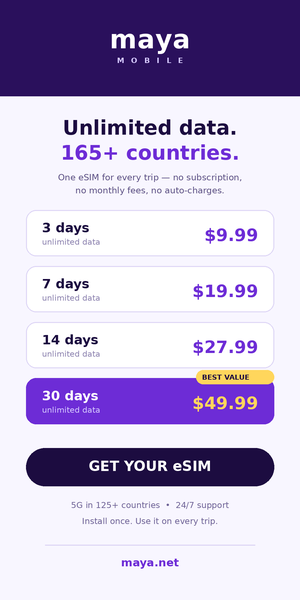
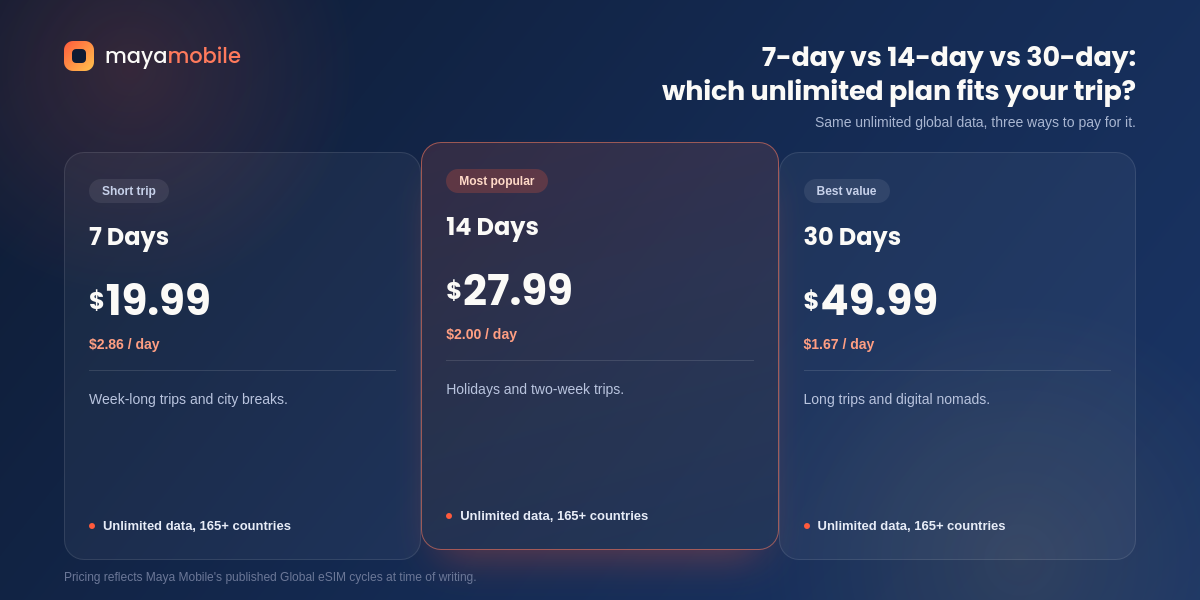
The 7-day plan is designed around a one-week period. Maya currently lists its global 7-day unlimited plan at USD 19.99.
At the listed price, that works out to approximately USD 2.86 per day.
A seven-day plan can be a natural fit if your trip is around a week long. For example, someone travelling for five, six, or seven days may not need to pay for a 14-day plan simply to have enough validity.
This type of plan can also work well for shorter international holidays where most of the trip is spent in one destination.
Think about a traveller taking a week-long trip to Paris, Bangkok, Tokyo, Rome, New York, or another supported destination. Instead of relying entirely on hotel Wi-Fi or paying their home carrier for international roaming, they can use a travel eSIM for mobile data during the trip.
The seven-day option can also be useful for business travellers making short international trips. If the itinerary is only a few days long, a longer validity period may not be necessary.
However, travellers should pay attention to when the plan begins. Maya Mobile’s current information states that the plan starts when the Maya eSIM is enabled. That means travellers should understand the activation process rather than assuming that purchasing the plan automatically starts the travel period immediately.
The 7-day option is worth considering if your trip is roughly one week long and you want a simple way to budget for mobile connectivity.
It can be particularly suitable for:
Week-long vacations
Short international business trips
City breaks
Short family holidays
Weekend trips extended into a full week
Travellers who know they will not need mobile data beyond seven days
The main advantage is straightforward: you are choosing a validity period that closely matches a short trip.
If your trip is only six days, you may not need 14 days of service. If you are travelling for exactly a week, the 7-day option gives you a plan designed around that timeframe.

The 14-day plan is designed for travellers who need connectivity for two weeks.
Maya currently lists its global 14-day unlimited plan at USD 27.99, which is approximately USD 2.00 per day based on the listed price.
For many travellers, two weeks is a very common holiday length. A 14-day plan therefore sits between a short trip and an extended journey.
It can work particularly well for people taking a two-week vacation, travelling across several destinations, or combining different parts of a country or region during the same trip.
For example, someone could spend several days in one city, move to another destination, and continue travelling for another week. Having a 14-day eSIM can provide a straightforward connectivity option throughout the trip, provided the destinations are covered by the plan.
The 14-day plan also makes sense when your itinerary is longer than seven days but nowhere near a full month.
Rather than purchasing another short-term plan after the first week, you can select a validity period that covers the entire two-week journey.
The 14-day plan can be a practical choice for travellers taking a typical two-week holiday.
It may suit:
Two-week vacations
Longer city-hopping trips
Family holidays lasting around 10 to 14 days
Multi-destination international trips
Business and leisure trips lasting up to two weeks
Travellers who want connectivity for the whole trip without changing plans midway
The 14-day option also has a lower listed daily cost than the 7-day plan. At the current listed prices, the 7-day plan works out to about USD 2.86 per day, while the 14-day plan works out to about USD 2.00 per day.
That does not automatically mean the 14-day plan is the right choice for everyone. The validity period should still match the actual trip. There is little benefit in paying for additional days that you will not use simply because the daily rate is lower.
The 30-day plan is designed for travellers who need connectivity for a significantly longer period.
Maya currently lists its global 30-day unlimited plan at USD 49.99, equivalent to approximately USD 1.67 per day based on the listed price.
That is the lowest daily price among the three plans discussed in this article.
A 30-day plan can make sense for people spending several weeks abroad. It can also be useful for digital nomads, long-term travellers, students travelling internationally, or anyone whose trip does not fit neatly into a one- or two-week itinerary.
For someone travelling for three or four weeks, having a 30-day validity period can be simpler than trying to combine shorter plans.
It can also be helpful when a traveller does not know exactly how much time they will spend in each destination but knows the overall journey will last around a month.
For example, imagine a traveller taking a month-long trip through several countries. Instead of thinking about mobile connectivity every seven or fourteen days, a 30-day plan gives them a single longer validity period for the journey.

The 30-day option is particularly relevant when the trip is longer than two weeks.
It may suit:
Month-long vacations
Extended international travel
Digital nomads
Long business trips
Students spending several weeks abroad
Travellers visiting multiple countries
People who want to avoid renewing a short-term plan during a longer trip
The lower daily price can also make the 30-day option worth considering when you know you will genuinely need connectivity for several weeks.
However, a longer validity period should not be confused with unlimited high-speed usage. Maya’s terms explain that its plans have a daily high-speed data allowance. After that allowance is used, data remains available at standard speed and the high-speed allowance resets every 24 hours.
That is an important distinction for anyone who expects to use large amounts of mobile data every day.
The simplest way to compare the three plans is by looking at their current listed duration and price.
The 7-day global plan is currently listed at USD 19.99, or about USD 2.86 per day.
The 14-day global plan is currently listed at USD 27.99, or about USD 2.00 per day.
The 30-day global plan is currently listed at USD 49.99, or about USD 1.67 per day.
This means the longer plans currently have a lower daily cost.
The important thing, though, is not simply choosing the plan with the lowest daily price. The better approach is to start with your travel dates.
If you are travelling for seven days, the 7-day plan is the closest match.
If you are travelling for ten to fourteen days, the 14-day plan provides more suitable coverage for the length of the trip.
If you are travelling for several weeks, the 30-day option becomes more relevant.
Travel costs can quickly add up. Flights, accommodation, meals, transportation, attractions, insurance, and other expenses all compete for space in the travel budget.
Mobile connectivity is usually only one part of that budget, but it is an expense that travellers can plan for before departure.
Maya Mobile’s current global pricing gives travellers a predictable starting point.
The 7-day plan is USD 19.99.
The 14-day plan is USD 27.99.
The 30-day plan is USD 49.99.
The difference between seven and fourteen days is USD 8 based on these listed prices. The difference between fourteen and thirty days is USD 22.
The daily rate becomes lower as the validity period increases.
That makes the 30-day option particularly interesting for someone who actually needs a month of connectivity. But if you only need service for six or seven days, buying a 30-day plan purely because the daily rate is lower may not be the most sensible way to look at the cost.
The number of days you actually need should remain the starting point.

This is one of the most important details to understand before buying a Maya Mobile plan.
Maya Mobile’s current global plans are advertised as unlimited data plans. However, the company’s terms provide more detail about how the service works.
Each plan includes a daily high-speed data allowance. Data can be delivered at up to 4G LTE or 5G where those network technologies are available on local networks.
After the daily high-speed allowance has been used, data is not completely cut off. Instead, the connection continues at standard speed. The high-speed allowance then resets every 24 hours.
This distinction is important.
Someone who mainly uses messaging, maps, email, browsing, and occasional social media may have a different experience from someone who regularly streams high-resolution video, uploads large files, or uses their phone as a heavy hotspot.
The exact network experience can also depend on local network conditions.
Maya’s terms state that specific speeds are not guaranteed, so travellers should not interpret the plan as a guarantee of unlimited high-speed data at a particular speed throughout the entire day.
Understanding this before purchasing helps set realistic expectations.
For a trip lasting approximately one week, the 7-day plan is the most direct match.
A seven-day holiday does not normally require a 14-day or 30-day validity period unless there is another reason for wanting the longer plan.
The 7-day option can be especially convenient for a short city break because you can arrange your connectivity for the length of your stay and avoid relying exclusively on Wi-Fi.
It is also worth considering the timing of your trip. If your travel dates are very close to seven days, pay attention to when the eSIM is enabled and when the validity period begins.
The key question is simple: “How many days will I actually need mobile data?”
If the answer is around seven, start with the 7-day option.
For a trip of around two weeks, the 14-day plan is the natural option to consider.
It provides a validity period that matches a standard 14-day itinerary and currently has a lower daily listed price than the 7-day plan.
This can be useful for travellers who are moving between several destinations during the same holiday.
A two-week trip can also be long enough that depending only on hotel, airport, café, or public Wi-Fi becomes inconvenient. Having a mobile data connection can make everyday travel tasks easier.
Maps, translation tools, messaging, travel apps, booking confirmations, and online research are all easier to use when you have a connection available while away from Wi-Fi.

For a journey lasting around a month, the 30-day plan is the most directly aligned with the trip duration.
The current listed price is USD 49.99, and the listed daily rate is approximately USD 1.67.
This makes it the lowest daily price of the three plans.
The 30-day option can be particularly relevant for digital nomads and long-term travellers because their connectivity needs may continue well beyond a conventional holiday.
Someone working remotely while travelling may also value having a longer validity period rather than thinking about their eSIM every week.
Again, the daily high-speed allowance is an important consideration for heavy users.
If your work involves video calls, cloud applications, file transfers, or other data-intensive activities, you should consider how you expect to use the connection rather than looking only at the word “unlimited.”
A 10-day trip sits between the 7-day and 14-day options.
In this situation, the 14-day plan may be the more natural choice because a seven-day validity period would not cover the entire trip.
Instead of trying to find another solution for the final few days, a 14-day plan provides a validity period that covers the full itinerary.
The important point is that travellers should compare the actual validity they need rather than automatically selecting a plan based on the lowest price.
A plan that expires before you return home can be inconvenient.
A 20-day trip is another situation where the 30-day option becomes relevant.
The seven-day plan is too short to cover the journey by itself, while the 14-day plan would also leave part of the trip outside its validity period.
A 30-day plan can therefore simplify the situation by providing enough validity for the entire journey.
The lower daily price also makes the 30-day option increasingly relevant for longer trips.
For travellers who are away for three weeks or more, it is worth looking at the 30-day option rather than thinking only in terms of short plans.
Multi-country trips are one area where a global eSIM can be particularly convenient.
Instead of buying a different physical SIM in every country, a traveller can use an eSIM designed for multiple supported destinations.
Maya Mobile currently says its global eSIM works across more than 165 countries.
That does not mean every possible destination is automatically included in every situation, so travellers should check the supported destinations for their itinerary before purchasing.
For someone travelling through several countries over two or four weeks, a global plan can reduce the need to repeatedly think about local SIM cards.
This is particularly useful for travellers crossing borders frequently.
Imagine a trip that includes Thailand, Singapore, Japan, and South Korea. Rather than treating each country as a separate connectivity problem, a traveller can check whether the destinations are supported and select a plan based on the total trip length.
The duration and destination coverage are separate questions. You need both to match your itinerary.

Frequent travellers may appreciate the fact that Maya Mobile uses an eSIM rather than requiring a physical SIM card.
Once an eSIM is installed on a compatible device, it can be used as a digital mobile connection for supported travel.
Maya Mobile’s current app information also describes the service around the idea of installing the eSIM and using it for future trips.
This can be useful for someone who travels internationally several times a year.
Instead of searching for a new physical SIM every time, the traveller can manage their travel connectivity digitally.
However, device compatibility remains important. Your phone or tablet must support eSIM functionality, and travellers should check compatibility before relying on the service.
There is a simple way to approach the decision.
Start with your travel dates.
If you need connectivity for about one week, look at the 7-day plan.
If you need connectivity for around two weeks, look at the 14-day plan.
If you need connectivity for several weeks or close to a month, look at the 30-day plan.
Then look at your expected data usage.
If you are mostly checking maps, messages, email, browsing, social media, and travel information, your usage pattern will be different from someone who spends hours streaming video or transferring large files every day.
Finally, check the countries you will visit.
The global plan covers more than 165 countries, but your exact destinations should still be checked before purchase.
Before buying any travel eSIM, it is worth spending a few minutes checking the practical details.
First, make sure your phone is eSIM-compatible.
Second, check whether your destination is included in the plan you are considering.
Third, check the plan’s validity period and make sure it matches your travel dates.
Fourth, understand the data policy. With Maya Mobile’s current global plans, “unlimited” means data continues after the daily high-speed allowance is used, but at standard speed until the high-speed allowance resets.
Fifth, check the network capabilities available at your destination. Maya says its plans can use 4G LTE or 5G where available on local networks, but actual service depends on local network conditions.
These checks take very little time but can help avoid surprises during the trip.

Travel connectivity is increasingly important for people who work while travelling.
Remote workers may need mobile data for email, messaging, navigation, online meetings, project management tools, and other work applications.
A 30-day plan can be particularly relevant to someone spending a month abroad.
However, anyone relying on an eSIM for work should think carefully about their expected data usage.
A person who occasionally checks email has very different requirements from someone who spends several hours a day in video meetings.
Because Maya’s terms distinguish between the daily high-speed allowance and standard-speed data after that allowance is used, heavy users should consider this before choosing a plan.
For important work trips, it can also be sensible to have a backup connectivity option, such as reliable Wi-Fi or another connection method.
Families often have several devices to think about when travelling.
Parents may need mobile data for navigation and communication, while children may use data for entertainment or other online activities.
A travel eSIM can provide an alternative to relying entirely on hotel Wi-Fi or paying a home carrier’s roaming rates.
The right Maya Mobile plan will depend on the family’s itinerary and device requirements.
A seven-day family holiday could point toward the 7-day plan, while a two-week vacation may make the 14-day plan more relevant.
For an extended family trip lasting several weeks, the 30-day option can provide a longer validity period.
Families should also check which devices are compatible with eSIMs and think about how much data each traveller is likely to consume.
Students can also benefit from having mobile data while abroad.
Whether travelling for a short course, study program, exchange, internship, or another educational experience, connectivity can be useful for communication, navigation, research, and everyday activities.
The correct plan depends on the length of the stay.
A one-week academic trip may fit the 7-day plan.
A two-week program may fit the 14-day option.
For a month-long educational trip, the 30-day plan may be more appropriate.
Students should pay particular attention to their expected usage if they plan to use mobile data for frequent video calls, streaming, or other high-data activities.
Maya Mobile’s current app information also describes an Auto Top-Up feature.
When enabled, the plan can renew automatically when it expires. Travellers who prefer to control each purchase manually can leave Auto Top-Up turned off.
This can be useful for longer or recurring travel, particularly for people who expect to continue using their Maya eSIM beyond the initial plan period.
However, automatic renewal is something travellers should understand before enabling it. If your trip is ending when your plan expires, you may prefer not to have an automatic renewal.
The feature therefore gives travellers another choice rather than changing the basic comparison between the 7-day, 14-day, and 30-day plans.

The 14-day plan occupies an interesting position between the shorter and longer options.
The 7-day plan is focused on short trips, while the 30-day plan is aimed at extended travel.
Fourteen days can work well for travellers who do not want to overpay for a month but need more than one week.
A two-week holiday is common enough that having a dedicated 14-day option can make the choice straightforward.
At the current listed prices, the 14-day plan also has a lower daily price than the 7-day plan.
That makes it worth considering when your trip is long enough to use the additional validity.
The main attraction of the 30-day plan is its combination of duration and daily pricing.
At USD 49.99, the current listed daily rate is approximately USD 1.67.
For someone travelling for 25 to 30 days, that can be a practical way to arrange mobile connectivity for the entire journey.
It can also make planning simpler.
Instead of buying one short plan, waiting for it to expire, and then arranging another, you have one longer plan covering the main travel period.
For digital nomads and long-term travellers, that simplicity can be useful.
There is no reason to make the decision more complicated than it needs to be.
The first question is how long you will be travelling.
Seven days points toward the 7-day plan.
Ten to fourteen days points toward the 14-day plan.
Several weeks points toward the 30-day plan.
The second question is where you are travelling.
Maya Mobile’s global plan currently supports more than 165 countries, but you should confirm your destinations before purchasing.
The third question is how you will use your data.
“Unlimited” should not be interpreted as unlimited high-speed data without conditions. Maya’s current terms explain that high-speed usage is subject to a daily quota, after which data continues at standard speed until the high-speed allowance resets.
This is particularly important for people who use their phones heavily.

Maya Mobile’s 7-day, 14-day, and 30-day plans give travellers several straightforward choices based on trip length.
The 7-day plan, currently listed at USD 19.99, is designed for short trips and week-long travel.
The 14-day plan, currently listed at USD 27.99, fits travellers who need connectivity for around two weeks.
The 30-day plan, currently listed at USD 49.99, is designed for longer journeys and currently provides the lowest listed daily price of the three.
Maya Mobile also currently supports more than 165 countries through its global offering, making the service relevant for travellers whose itineraries cross borders.
The biggest thing to remember is that the right plan is not necessarily the one with the lowest daily price. It is the one that fits the length of your trip and your expected usage.
For a short holiday, there is little reason to choose a month-long plan simply because its daily rate is lower. For a month-long trip, on the other hand, the 30-day option can be a much more natural fit than repeatedly arranging shorter plans.
And if your trip falls somewhere in the middle, the 14-day option provides a useful balance between the two.
Maya Mobile’s eSIM approach can also make travel connectivity more convenient because there is no physical SIM card to swap. Once your compatible device is set up, you can use the eSIM for your travel connection in supported destinations.
Before travelling, check your device compatibility, confirm that your destinations are supported, review the current plan terms and pricing, and think honestly about how much high-speed data you are likely to use each day.
Once those details are clear, choosing between 7, 14, and 30 days becomes much easier.
For travellers who want to arrange their mobile data before leaving home and avoid depending entirely on public or hotel Wi-Fi, Maya Mobile is an option worth considering. Its current range of travel eSIM plans gives short-trip travellers and long-term travellers a way to choose a validity period that matches the journey.