



If you’ve recently launched a website, online store, blog, SaaS platform, or mobile app, you’ve probably realized that privacy compliance isn’t something you can ignore. Regulations such as the GDPR, CCPA/CPRA, and other privacy laws have made it important for businesses to provide clear privacy policies, manage user consent, and maintain transparency about data collection.
This is where Termly has become one of the most popular privacy compliance platforms for businesses of all sizes.

One of the first questions people ask before signing up is:
“Is Termly free?”
The short answer is yes—Termly offers a free plan that lets users access several privacy compliance tools. However, like many software platforms, some advanced features are available through paid plans.
In this guide, we’ll explain exactly what the free version includes, when it makes sense to upgrade, and why thousands of businesses choose Termly to simplify privacy compliance.
Termly is a privacy compliance platform that helps businesses create legal policies and manage user consent from one dashboard.
Instead of hiring a lawyer to draft every legal document from scratch, users answer a series of questions, and Termly generates customized legal policies based on the information provided.
Depending on your needs, Termly offers tools that help with:
Privacy policies
Cookie policies
Cookie consent banners
Terms and Conditions
Disclaimer policies
Refund policies
End User License Agreements (EULAs)
Website legal compliance management
The platform is designed for beginners while still providing features that growing businesses and larger organizations appreciate.
Yes.
Termly offers a Free Plan, allowing users to start creating important legal policies without paying upfront.
The free plan is ideal for people who want to:
Launch a new website
Start a personal blog
Test the platform
Learn about privacy compliance
Create basic legal documents
Many new website owners begin with the free plan before deciding whether they need more advanced compliance tools later.
This makes Termly particularly attractive for startups and small businesses that want to stay compliant without making a significant initial investment.
Although the exact feature limits may change over time, Termly’s free plan generally gives users access to core privacy compliance tools.
These typically include the ability to generate legal policies using Termly’s guided questionnaire and publish them on your website.
The platform is designed so that even someone with little legal knowledge can create professional-looking policies in minutes.
For many small websites, this can be enough to get started while learning more about privacy requirements.
Many software companies use a “freemium” model.
The goal is simple:
Users can experience the platform before deciding whether premium features are necessary.
This approach benefits everyone.
Users can:
Explore the interface
Understand how policy generators work
Build confidence in the platform
Decide whether premium features provide enough value
Instead of paying before knowing whether the service meets your needs, you can actually try it first.
The free plan works particularly well for certain types of users.
If you run a hobby blog or personal website, you may only need basic legal pages while your audience grows.
Rather than spending hundreds of dollars on legal documents, you can start with Termly’s free tools.
Students creating portfolios, projects, or educational websites often have limited budgets.
A free privacy compliance solution makes much more sense than hiring legal professionals for a simple project.
Freelancers frequently build landing pages to showcase services.
Having a privacy policy adds professionalism and builds trust with potential clients.
Termly makes this process straightforward.
Many local businesses are just beginning their online journey.
Whether you’re a photographer, consultant, fitness coach, or restaurant owner, having legal policies on your website demonstrates transparency.
The free plan allows small businesses to establish a compliance foundation without immediate costs.
Every startup tries to control expenses during its early stages.
Instead of allocating a large legal budget immediately, founders can begin with Termly’s free tools and upgrade later if their compliance requirements become more advanced.
While the free plan is useful, businesses with growing websites often require more advanced compliance functionality.
Paid plans generally provide access to additional capabilities such as more extensive policy management, broader compliance tools, and enhanced cookie consent features.
Organizations handling larger amounts of user data or operating across multiple jurisdictions may find these additional features valuable.
As your website grows, privacy compliance often becomes more complex, making premium tools increasingly helpful.
Some website owners assume legal policies are only necessary for large corporations.
In reality, privacy compliance affects businesses of every size.
Even a simple blog may collect information through:
Contact forms
Analytics tools
Newsletter signups
Cookies
Advertising platforms
Embedded videos
Social media plugins
Visitors increasingly expect transparency regarding how their information is collected and used.
Having clear legal documentation helps explain your practices and demonstrates professionalism.
Many people view privacy policies as something visitors never read.
While not everyone studies every line, having an accessible privacy policy serves several important purposes.
It can:
Build visitor trust
Improve transparency
Explain data collection practices
Support business credibility
Help users understand their rights
When visitors see clearly written legal pages, they’re more likely to feel comfortable interacting with your website.
Cookies power many modern websites.
They help remember preferences, measure traffic, personalize experiences, and support advertising.
However, many privacy regulations require websites to inform visitors about cookie usage and, in some cases, obtain consent before placing certain cookies.
This is one reason why cookie consent management has become an essential part of website compliance.
Termly provides cookie-related compliance solutions alongside its policy generators, making it easier for businesses to manage these requirements from a single platform.
There are many privacy compliance platforms available today, yet Termly has become a popular choice because it focuses on making complex legal requirements easier to understand.
Instead of presenting users with technical legal language from the beginning, the platform walks them through guided questionnaires and generates documents based on the information they provide.
This approach helps reduce confusion for website owners who don’t have legal expertise.
Additionally, having multiple compliance tools available within one platform means users can manage policies and consent solutions together rather than relying on several separate services.
One of the biggest misconceptions about software with a free plan is that it’s either too limited to be useful or that it hides important features behind paywalls. In reality, Termly’s approach is designed to let users get started without paying while offering additional capabilities for businesses with more advanced compliance needs.
For many personal websites or small projects, the free plan may provide enough functionality to create essential legal documents and understand the platform.
As a website grows, however, compliance often becomes more demanding. More visitors, additional marketing tools, and expanding operations can introduce new privacy obligations. That’s when users may decide that upgrading to a paid plan is worthwhile.
The key is that you can begin with the free version and evaluate whether premium features match your business requirements over time.
For many small websites, the answer is often yes.
If your website is relatively simple and you are just getting started, you may only need a few essential legal policies.
Examples include:
Personal blogs
Portfolio websites
Small informational websites
Landing pages
Early-stage startup websites
Local business websites
These websites generally have fewer compliance requirements compared to large online businesses handling thousands of customer interactions every day.
Starting with the free plan allows website owners to establish a compliance foundation without increasing startup costs.
There isn’t a single moment when every business should upgrade. Instead, it depends on how your website evolves.
You might consider a paid plan if:
Your website receives significant traffic.
You operate in multiple countries.
You collect customer information regularly.
Your business relies heavily on online marketing.
You use numerous third-party integrations.
You want access to more advanced compliance management features.
Rather than upgrading simply because your business is growing, it’s better to evaluate your actual compliance needs.
One of Termly’s biggest strengths is its user-friendly design.
Legal compliance can sound intimidating, especially for someone launching their first website.
Instead of requiring users to understand complicated legal terminology, Termly guides them through a step-by-step questionnaire.
Users answer questions about topics such as:
Business type
Website purpose
Data collection practices
Third-party services
Marketing tools
Contact information
Based on those answers, the platform generates legal documents tailored to the information provided.
This guided experience significantly reduces the learning curve.
This is an important question.
While Termly provides automated legal policy generators and compliance tools, it should not be viewed as a substitute for personalized legal advice in every situation.
Businesses with unique legal circumstances, highly regulated industries, or complex contractual needs may still benefit from consulting a qualified attorney.
However, for many small businesses and website owners, automated policy generation offers a practical and cost-effective starting point for meeting common privacy compliance requirements.
There are several advantages to beginning with the free version before deciding on a paid subscription.
Launching a website already involves expenses such as:
Domain registration
Web hosting
Design
Marketing
Email services
SEO tools
Adding another subscription immediately may not fit every budget.
The free plan lets users begin working on compliance without increasing upfront costs.
Every software platform has its own interface and workflow.
Using the free plan gives you time to understand how Termly works before investing in additional features.
This reduces the chances of paying for software that doesn’t match your expectations.
Privacy compliance can feel overwhelming.
Using a guided platform helps website owners become familiar with important concepts like:
Privacy policies
Cookie notices
User consent
Data transparency
As confidence grows, upgrading becomes a more informed decision rather than a guess.
Although every business has different needs, there are several reasons why many website owners choose Termly.
The platform is designed to simplify legal document creation.
Instead of starting with a blank page, users answer guided questions that help generate relevant policies.
Not everyone has legal or technical experience.
Termly’s dashboard is organized to help users navigate compliance tools without unnecessary complexity.
Writing legal documents from scratch can take days or even weeks.
Automated policy generation dramatically reduces that time, allowing businesses to focus on other priorities.
Rather than using one provider for privacy policies and another for cookie consent, users can manage multiple compliance-related tools within a single platform.
This centralized approach can make ongoing compliance easier to maintain.
Let’s clear up a few common misconceptions.
Not necessarily.
Many software companies use free plans to introduce users to their products.
The goal is to provide genuine value while offering premium features for businesses with more advanced requirements.
This isn’t accurate.
Even small websites often collect personal information through contact forms, analytics, cookies, or newsletter signups.
Transparency about data collection is important regardless of company size.
Privacy compliance isn’t something you complete once and forget.
As your website changes—whether by adding new tools, expanding services, or entering new markets—your legal documentation may need updates.
Using a platform that helps manage policies over time can make this ongoing process more manageable.
One advantage of using a scalable platform is that your compliance solution can grow alongside your business.
Many companies begin with a simple website but later expand to include:
E-commerce functionality
Customer accounts
Membership areas
Online bookings
Marketing automation
International customers
As operations become more sophisticated, privacy compliance typically becomes more complex as well.
Having access to both free and premium options means businesses can adapt their compliance strategy without switching platforms.
Online stores generally collect more customer information than informational websites.
For example, an e-commerce website may process:
Customer names
Email addresses
Shipping information
Billing details
Payment-related information through payment providers
Marketing preferences
Because of this, e-commerce businesses often pay close attention to privacy compliance.
Termly provides tools that can help online businesses create important legal policies and manage consent requirements based on their website’s needs.
Modern consumers are becoming increasingly aware of how businesses collect and use personal information.
Visitors appreciate websites that clearly explain:
What information is collected
Why it’s collected
How it’s used
Whether it’s shared with third parties
How users can exercise their privacy rights
Clear legal documentation isn’t just about meeting compliance requirements—it also demonstrates openness and professionalism.
For businesses aiming to build long-term customer relationships, transparency can be an important trust factor.
If you’re curious about privacy compliance but aren’t ready to commit to a subscription, the free plan provides a practical way to explore the platform.
It allows you to familiarize yourself with the policy generation process, understand the dashboard, and begin building essential legal documentation for your website.
For many new website owners, this is an excellent first step before deciding whether advanced features are necessary as their business grows.
Managing a website involves much more than publishing content or selling products. Business owners often rely on several tools to keep everything running smoothly, including analytics platforms, email marketing software, customer relationship management (CRM) systems, payment processors, and advertising networks.
Many of these services involve the collection or processing of user data, making privacy compliance an ongoing responsibility rather than a one-time task.
Termly is designed to help website owners manage this aspect of running a website by providing tools for generating legal policies and supporting consent management. Instead of manually updating documents every time your website evolves, using a dedicated compliance platform can make the process more organized and efficient.
For growing businesses, having compliance tools in one place can save time and reduce administrative work.
If you decide to start with the free version, there are a few best practices that can help you maximize its value.
The quality of any generated legal policy depends on the accuracy of the information you provide.
Take your time when completing the questionnaires and ensure that details about your website, business, and data collection practices are correct.
Although Termly generates policies based on your responses, it’s always a good idea to review each document before making it publicly available.
Check that:
Business details are accurate.
Contact information is current.
Website URLs are correct.
Descriptions of your services match your actual business.
Small mistakes can create confusion for visitors, so a final review is worthwhile.
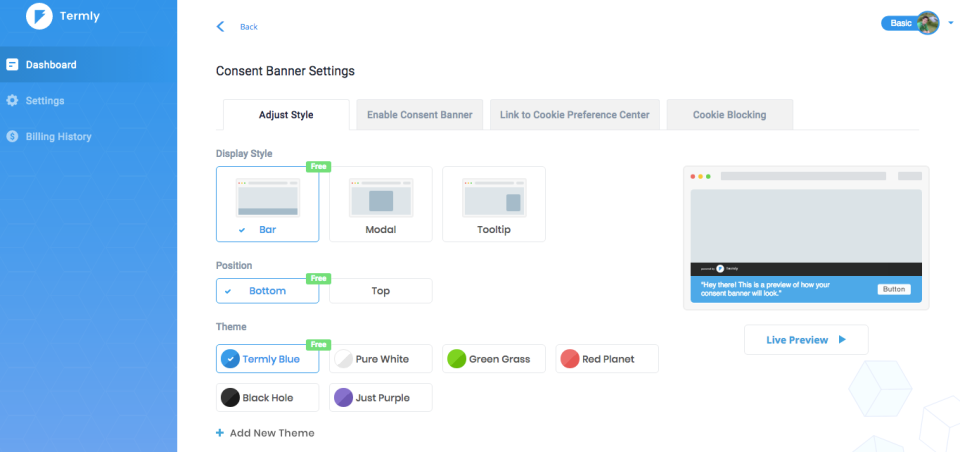
Websites rarely stay the same for long.
You may eventually add:
New plugins
Marketing tools
Payment options
Contact forms
Analytics platforms
Advertising services
Whenever your website changes in ways that affect how personal information is collected or processed, it’s important to review your legal documentation to ensure it still reflects your current practices.
While tools like Termly simplify compliance, having a basic understanding of privacy principles can help you make better decisions for your website.
Topics worth learning include:
Personal data
Cookies
Consent
User rights
Data transparency
Privacy notices
Even a general understanding of these concepts can help you use compliance tools more effectively.
Termly offers a free plan that allows users to access certain privacy compliance tools. It also offers paid plans that include additional features for users with more advanced compliance requirements.
Yes. Many bloggers use privacy compliance tools to create legal pages for websites that collect visitor information through analytics, contact forms, newsletter subscriptions, or cookies.
Yes. Termly provides policy generators that guide users through a questionnaire and generate legal documents based on the information they provide.
Yes. Startups often begin with limited budgets, making a free plan an attractive way to establish foundational privacy documentation while their business grows.
Many e-commerce businesses use privacy compliance platforms to help create legal policies and manage consent requirements. The specific tools needed depend on how the online store operates and what customer information it collects.
No. One of Termly’s strengths is its beginner-friendly interface. The guided setup process is designed to help users generate policies without requiring coding or legal expertise.
Yes. Businesses can start with the free plan and choose to upgrade later if they need additional compliance features or expanded functionality.
Like any software platform, Termly has strengths that appeal to a wide range of website owners.
Some of its notable advantages include:
Free plan available for new users
User-friendly interface
Guided policy generators
Multiple compliance tools in one platform
Suitable for businesses of different sizes
Helpful for websites, blogs, and online stores
Scalable as your compliance needs grow
These benefits make it a practical option for anyone looking to simplify website compliance without starting from scratch.
Before selecting a privacy compliance solution, it’s helpful to think about your current and future requirements.
Ask yourself questions such as:
What type of website do I operate?
Which countries are my visitors from?
What personal information do I collect?
Do I use cookies or analytics tools?
Will my business likely grow over the next few years?
Do I need only legal policies, or additional consent management features as well?
Answering these questions can help you determine whether a free plan is sufficient or whether investing in a more comprehensive solution makes sense.
Yes—Termly offers a free plan, making it accessible for individuals, bloggers, startups, and small businesses that want to begin addressing website privacy compliance without an upfront subscription cost.
The free plan provides an opportunity to explore the platform, generate essential legal documents, and become familiar with compliance basics. As your website expands and your privacy obligations become more complex, you can evaluate whether the additional features available through paid plans align with your business needs.
One of Termly’s biggest advantages is its focus on simplicity. Rather than expecting users to understand complicated legal terminology, it provides guided tools that help make the process of creating legal policies more approachable.
Whether you’re launching your very first website or managing an established online business, having clear privacy documentation and transparent data practices is an important part of building trust with your audience.
If you’re looking for a platform that allows you to start with a free plan while offering room to grow as your compliance requirements evolve, Termly is certainly worth considering.
Privacy compliance has become an essential part of operating a modern website, regardless of its size. From personal blogs to online stores and growing startups, visitors expect transparency about how their information is collected and used.
Termly helps simplify this process by offering easy-to-use policy generators and compliance tools through an intuitive platform. Its free plan gives new users the opportunity to create foundational legal documents without an immediate financial commitment, making it an excellent starting point for those exploring website compliance for the first time.
As your website grows, you can reassess your needs and decide whether additional features available through Termly’s paid plans provide value for your business. This flexibility allows users to start small while maintaining the option to expand their compliance toolkit in the future.
For anyone asking, “Is Termly free?”, the answer is straightforward: Yes, it offers a free plan, and for many individuals and small businesses, it’s an excellent way to begin building a more transparent and privacy-conscious online presence.